In lane Electric Vehicles
China EV Sales Reach 65% Share as Leapmotor Surges in August
Description
Plug-in cars made up 65% of China’s August sales as Leapmotor climbed to 84,874 registrations and new small EVs crowded the rankings.

China’s car market contracted sharply in August, but electric models gained ground as combustion sales fell faster. Plug-in vehicles reached a record 65% of new-car sales, including 45% for battery-electric vehicles (BEVs), while Leapmotor posted one of the month’s biggest manufacturer gains. The figures point to a market changing quickly even as total demand weakens.
A record electric share in a shrinking market
China recorded around 1.5 million vehicle sales in August, down 24% year over year. BEVs were the only powertrain type in the report to grow, edging up 1%. Plug-in hybrids (PHEVs) fell 30%, and extended-range electric vehicles (EREVs) declined 22%. Against that backdrop, the record share for plug-in vehicles reflects both steady BEV demand and a steep drop in combustion-powered sales.
BEVs accounted for 45% of the market and PHEVs for another 20%. Together, they put the plug-in share at 65%. For the year to date, plug-ins reached 57%, already three percentage points above the full-year 2025 share. BEVs made up 38%, compared with 33% for all of 2025. The report expects China to finish 2026 above 60% for plug-ins, with BEVs exceeding 40%.
The balance within the plug-in market is also shifting toward fully electric cars. BEVs represented 69% of plug-in sales in August, against 31% for PHEVs; the year-to-date split was 67% to 33%. That’s the highest BEV share since 2023, and a move back toward the 80%/20% mix seen in the Chinese market’s earlier years. The source points to PHEVs losing incentives at the end of 2026 as one factor that could strengthen that trend in 2027. It links to a report on the scheduled incentive change.
These are sales-mix figures, not a sign that the market is growing overall: August’s total fell even as electrification advanced. That distinction matters for automakers, which must compete for buyers in a contracting market while the powertrain mix moves decisively toward plug-ins. For buyers, the crowded field of lower-priced electric models is already visible in the sales rankings.
Exports extend Chinese automakers’ reach
Chinese automakers exported 888,000 vehicles in August, up 78% year over year. Plug-in vehicles made up 58% of those exports, compared with 40% in August 2025. The export mix means the shift toward electric cars is travelling with Chinese brands into overseas markets, rather than staying confined to domestic sales.
The report places that growth alongside the expanding presence of local automakers in several markets, naming Vietnam’s VinFast, Türkiye’s Togg, and India’s Tata and Mahindra. Established global brands face pressure both in China, the world’s largest car market, and in other regions where local competitors are building share. The scale and electrification of Chinese exports add another source of competition for manufacturers whose lineups still rely heavily on combustion models.
August’s overall top 10 models were all plug-ins, with eight BEVs. The report says it will stop publishing that list next month because the broad ranking has become repetitive. The more useful story now sits in the segments and models where established leaders are being challenged by new arrivals.
Small electric cars draw the fiercest contest
The segment rankings show plug-in vehicles filling every podium across five size categories. Only three models on those podiums were not fully electric. The report singles out the Fang Cheng Bao Tai 7’s strong showing against Xiaomi models, while cautioning that its lead may face pressure from Xiaomi’s forthcoming Skynomad, N70 and N90 SUVs, described in a linked report.
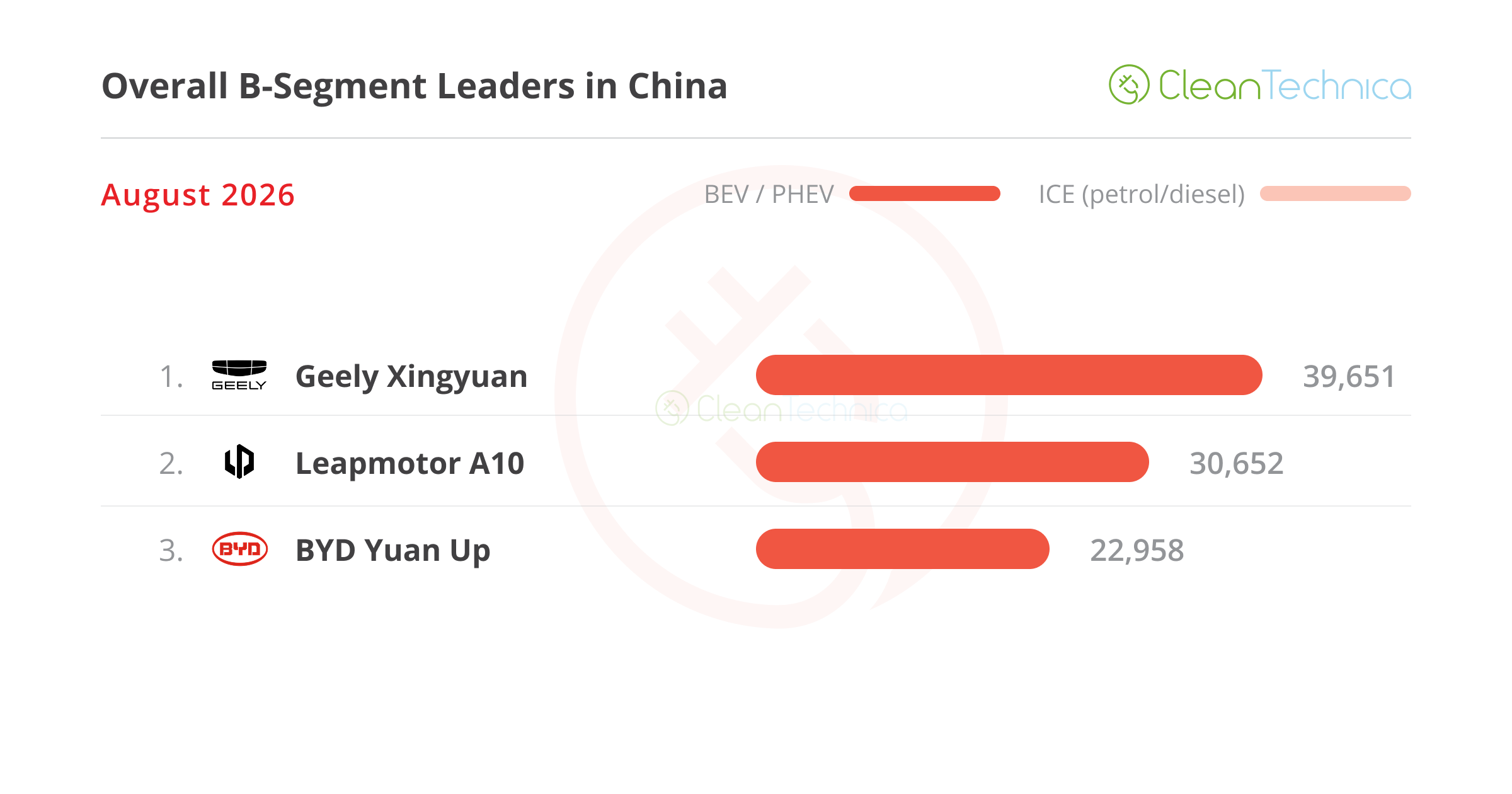
The B-segment compact-car category is especially busy. Geely’s Xingyuan remains the benchmark, and several rivals are targeting the same buyers. Leapmotor is adding production of its A10 crossover and has begun scaling up the A05 hatchback. The A05 recorded more than 8,000 sales in August, while a new-generation BYD Seagull is also due to arrive. The competition puts affordable, small electric cars at the center of China’s latest model battle.
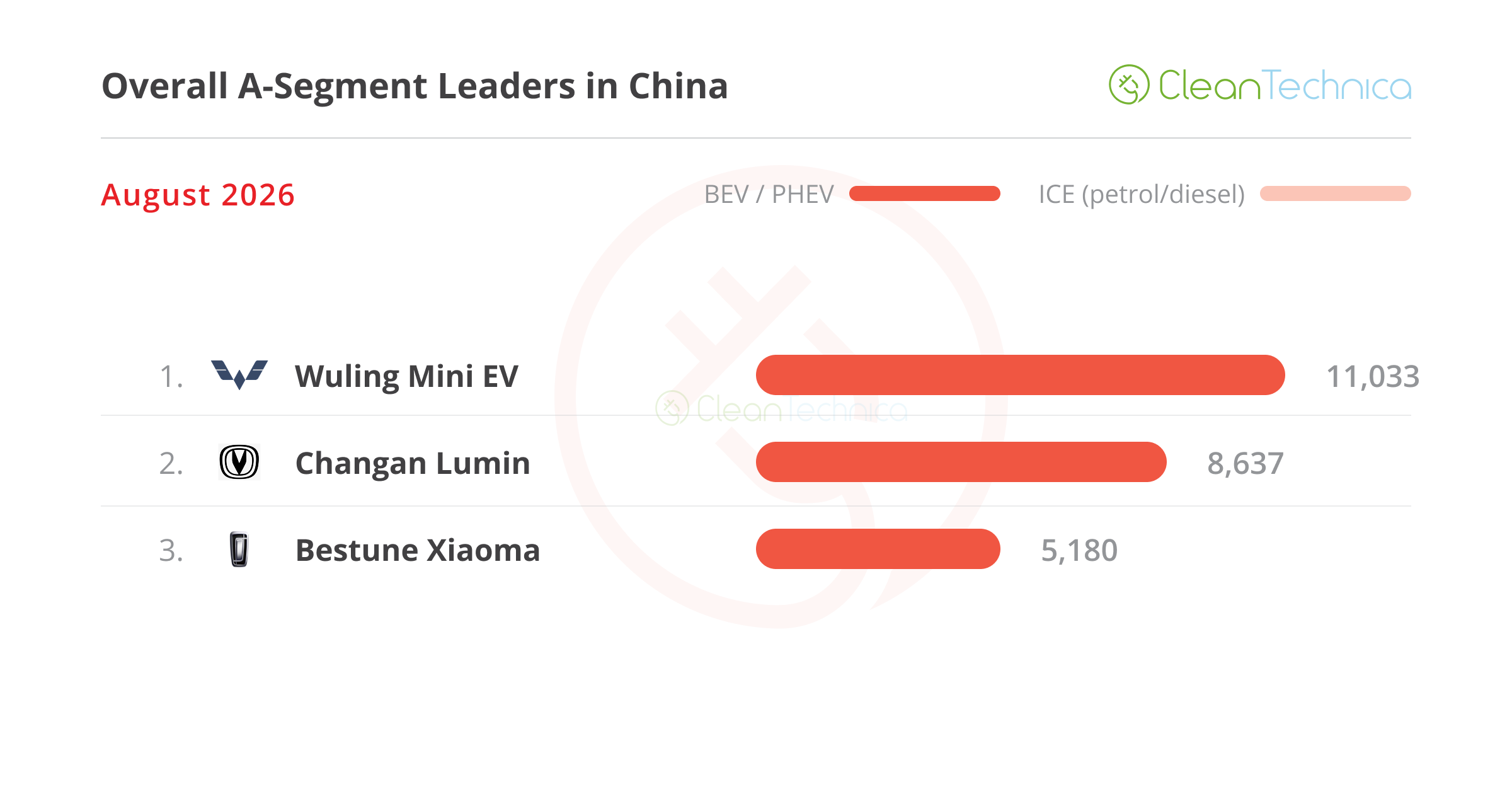
City cars, meanwhile, are recovering gradually after a subsidy reduction at the start of the year hurt sales. Wuling’s Mini EV remains the segment’s leading nameplate. Changan’s Lumin reached 8,637 units in August, its best month of the year, and took second place ahead of Bestune’s Xiaoma and Geely’s Panda. The source argues that the category could use new models, pointing readers to the BYD Racco.
Geely leads, while Leapmotor’s A10 climbs
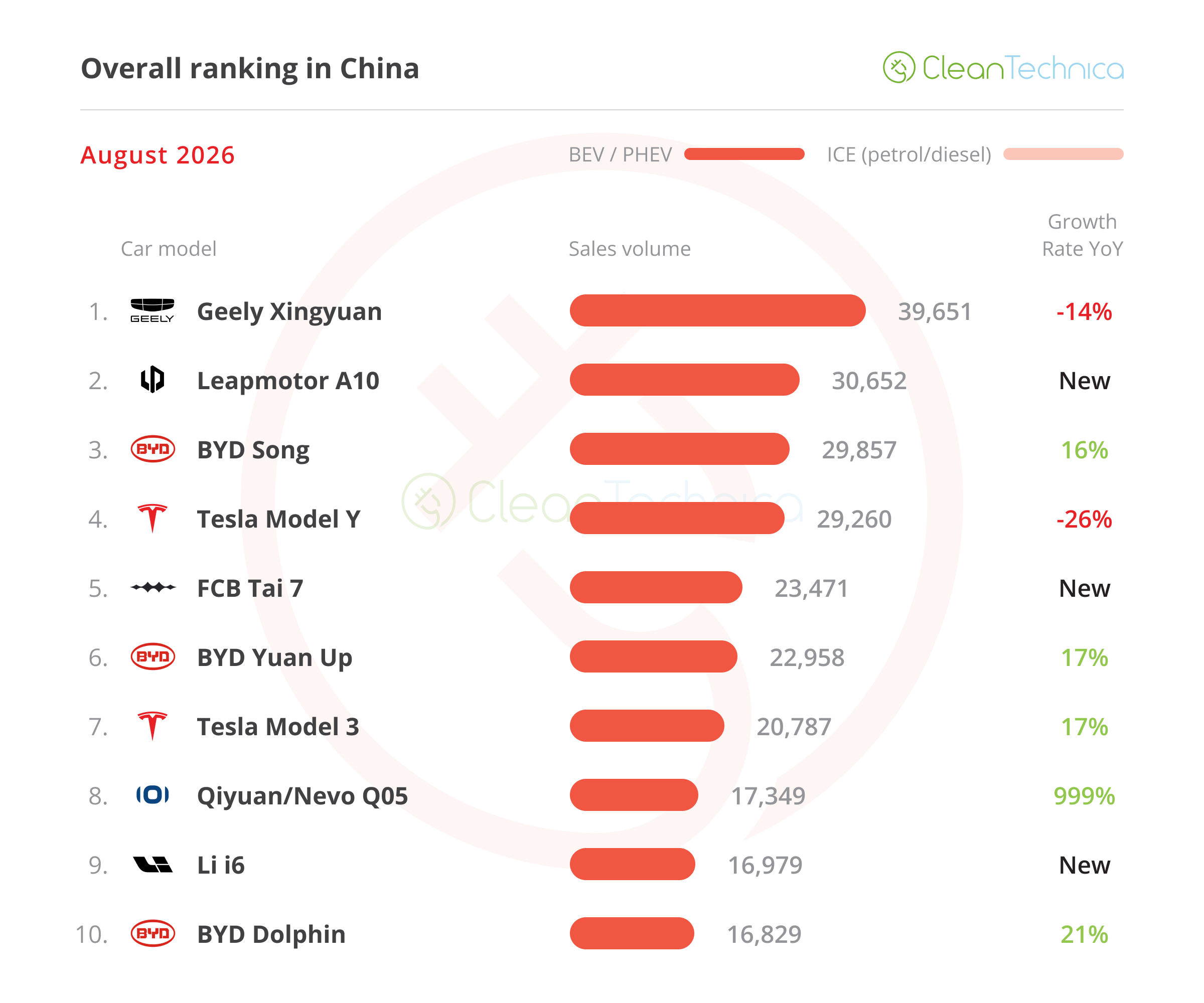
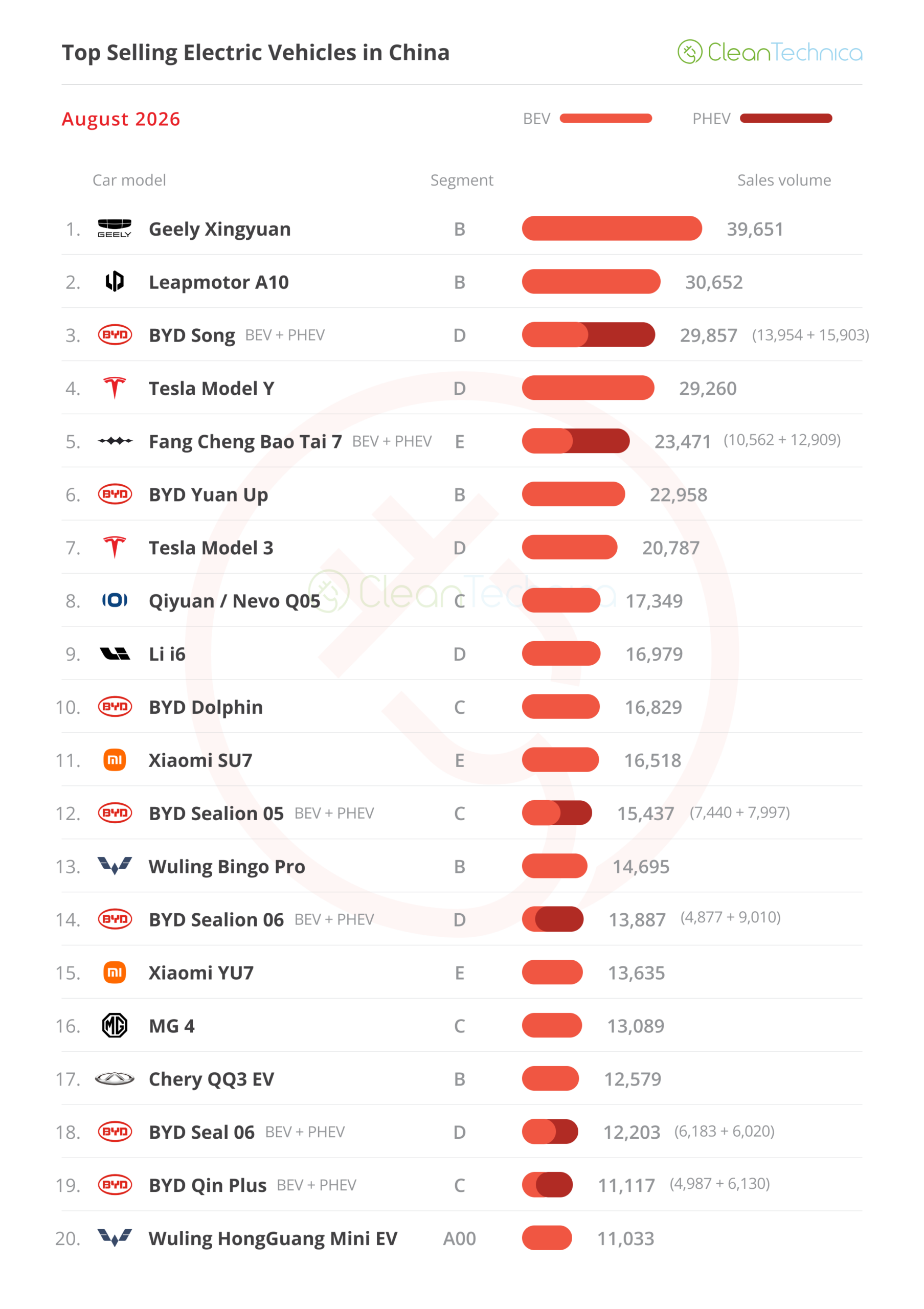
Geely’s Xingyuan held first place in August with 39,651 registrations. That was its strongest result since November, but still 14% below August 2025. Its core proposition, as described in the source, is a small hatchback offering aimed at buyers considering pricier alternatives such as the BYD Dolphin, with a price point comparable to the BYD Seagull at about $10,000. The model faces a growing list of competitors: Leapmotor’s A10 and A05, the new Wuling Bingo, Chery’s QQ3, BYD’s Yuan Up and the next-generation Seagull. Geely’s sales lead is real, but the pressure is building.
Leapmotor’s A10 took second place with 30,652 registrations as production continued to ramp up. Priced at 66,000 yuan, or $10,000, the small crossover follows the brand’s value-focused approach. The source also highlights styling that gives it a more distinct look than the restrained designs found elsewhere in Leapmotor’s lineup, including its lights and floating-roof effect. August’s result is a strong early marker; how high the A10 can climb will depend in part on how quickly output grows and how it performs against the Xingyuan and other small EVs.
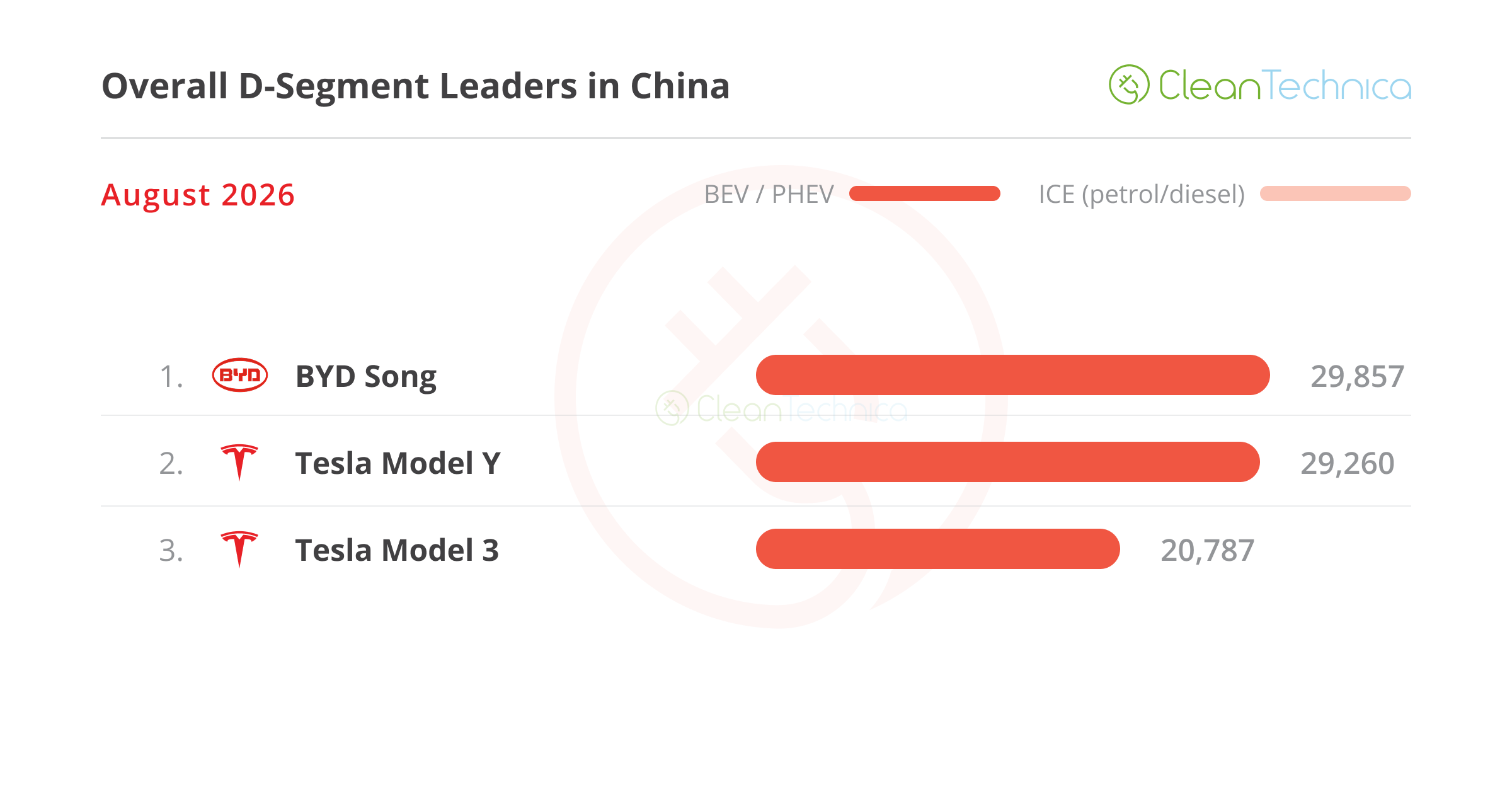
BYD’s Song, combining BEV and PHEV versions, finished third with 29,857 registrations, up 16% year over year. Sales benefited from the introduction of the new Ultra body as the model transitions to its next generation. The report says the new version adds lidar and 1,500 kW DC charging. It lists prices from 152,000 yuan ($22,000) with a 76 kWh battery to 180,000 yuan ($26,000) with an 83 kWh battery. For comparison, the Tesla Model Y starts at 259,000 yuan ($38,250) in China.
That price gap gives the Song a clear point of difference against Tesla’s midsize SUV, although the models’ equipment and versions aren’t identical. The source expects the Song to gain momentum as production of the new generation expands, and sees it as a contender for the final podium place in 2026. It also raises the possibility of a stronger challenge in 2027.
Model Y holds position as newer rivals advance
The Tesla Model Y ranked fourth with 29,260 deliveries, down 26% from August 2025. Its extended-wheelbase Model Y L is helping sustain demand, but the report sees limits to the impact of adding variants to a model that has been on sale for six years. As direct competitors adopt 800-volt platforms and add features, the Model Y faces a growing product-age challenge. It remains in line for a podium position in the full-year ranking, though the report is less confident about its prospects next year.
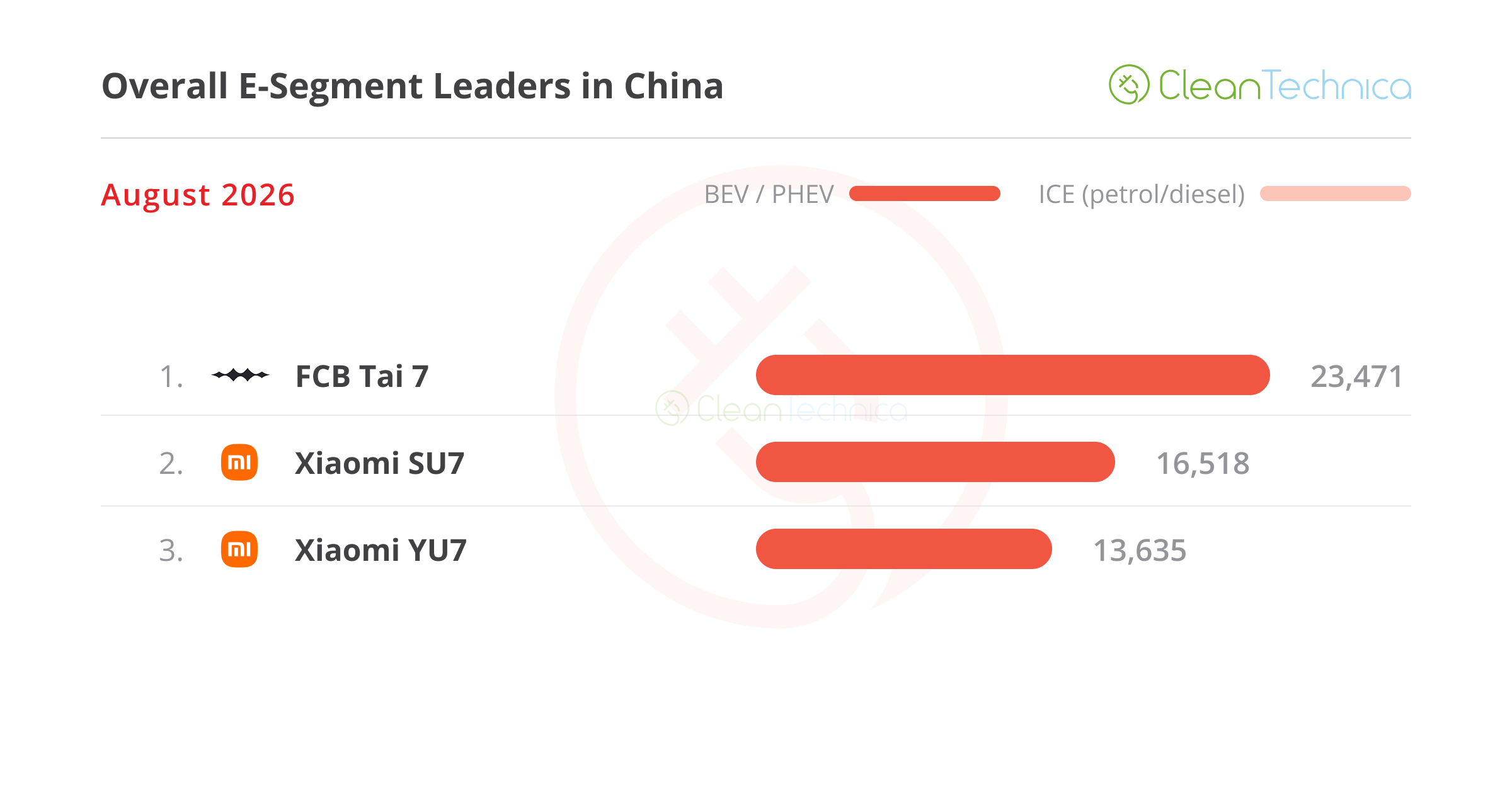
Fang Cheng Bao’s Tai 7 reached a year-best 23,471 registrations, placing fifth. Its BEV versions, with 92 and 106 kWh batteries, recently arrived with Flash Charging technology. They accounted for 12,909 sales in August, exceeding the PHEV versions’ 10,562. The report credits the Tai 7’s boxy styling, equipment and interior for its appeal in its price range, and sees possible export potential among buyers looking for large, rugged-looking SUVs.
BYD’s Yuan Up took sixth with 22,958 registrations, its best result since last September. That put three B-segment vehicles in the top six. The Tesla Model 3 made a notable return to form, ranking seventh with 20,787 registrations, its best monthly result of 2026. The source says there were no visible changes to its value proposition that clearly explain the jump, leaving open whether August was an isolated result or the start of a stronger run.
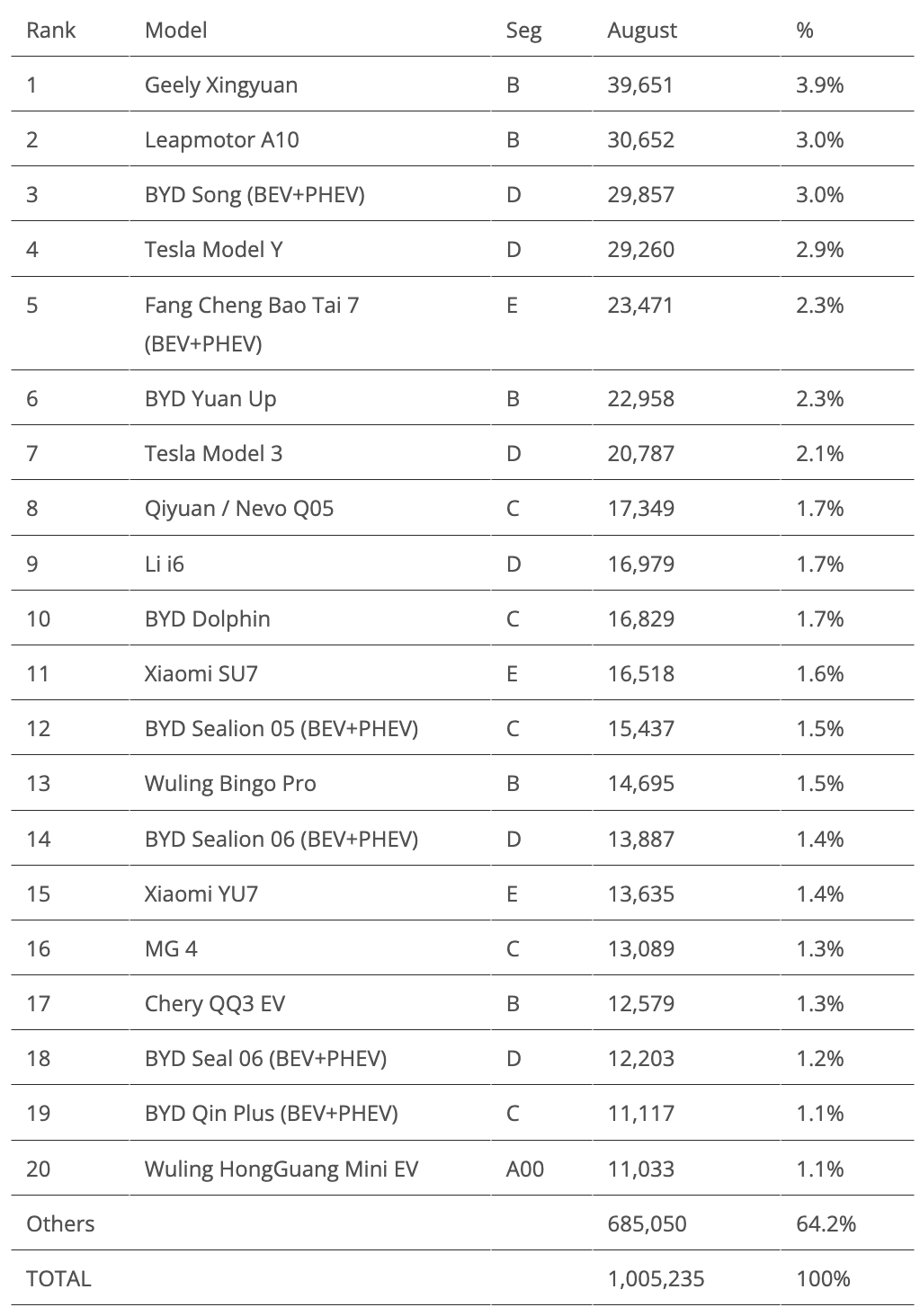
Elsewhere in the top 20, the new-generation Wuling Bingo delivered 14,695 units, its best monthly total so far and its strongest result since May 2025. Chery’s new QQ3 EV reached 12,579 registrations, a record for the model, and rose to 17th as production continued to build. Both add to the swelling ranks of compact BEVs competing for buyers.
New models broaden the field
Outside the top 20, Great Wall’s Haval H10 made a strong entry among large SUVs. The source gives its output at 600 hp and its weight at 2,600 kg, positioning it as a direct challenger to Fang Cheng Bao’s large SUVs. Those figures mark it as a substantial vehicle; August’s initial reception suggests it has found an audience, though the longer-term contest will depend on how it sustains sales against established rivals.

Chery’s luxury marque Luxeed also found early traction with the V9 minivan. In its fourth month on sale, it recorded 8,312 registrations and became China’s best-selling MPV. The report frames the result as a welcome boost for a group with a large number of marques, including Chery, Exeed, Jetour, iCar, Luxeed, Rely, Karry, Omoda, Jaecoo, Ebro and Lepas.
Xpeng’s Mona L03 crossover registered 8,424 units in its second month on the market, making it the brand’s best-selling model in August. Leapmotor’s A05 hatchback reached 8,340 registrations in its second month. The A05 and A10 overlap closely in the lineup, with the main visible distinction being the A10’s crossover ride height. Their sales will show whether Leapmotor can bring in separate groups of buyers or whether the hatchback takes demand from its sibling.


Year-to-date standings and manufacturer shifts
The year-to-date model podium remained unchanged in August. The report expects the Geely Xingyuan to retain first place, with the Model Y in second and BYD Song in third, unless an unexpected change disrupts the ranking. Fang Cheng Bao’s Tai 7 climbed to fifth, while the Leapmotor A10 rose two places to eighth as its output expanded. With the A10 still ramping up, the report sees a chance for it to finish ahead of the Tai 7.
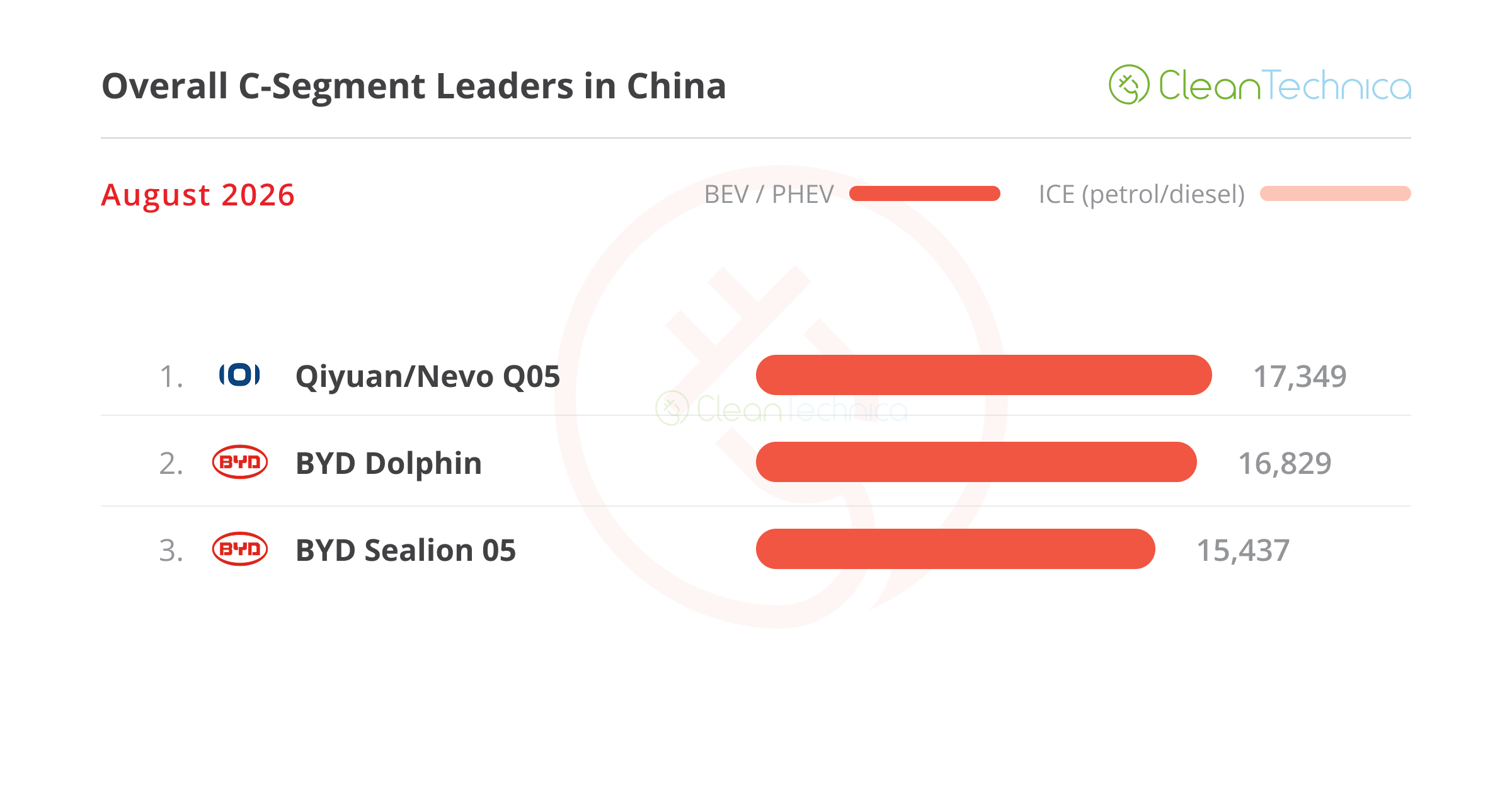
The BYD Dolphin rose to 13th and was just 41 units behind the NIO ES8 in 12th. The Tesla Model 3 re-entered the table in 17th, with the source expecting it could gain places in September. BYD’s Sealion 05 appeared in 19th and could become a more significant competitor in the compact category.
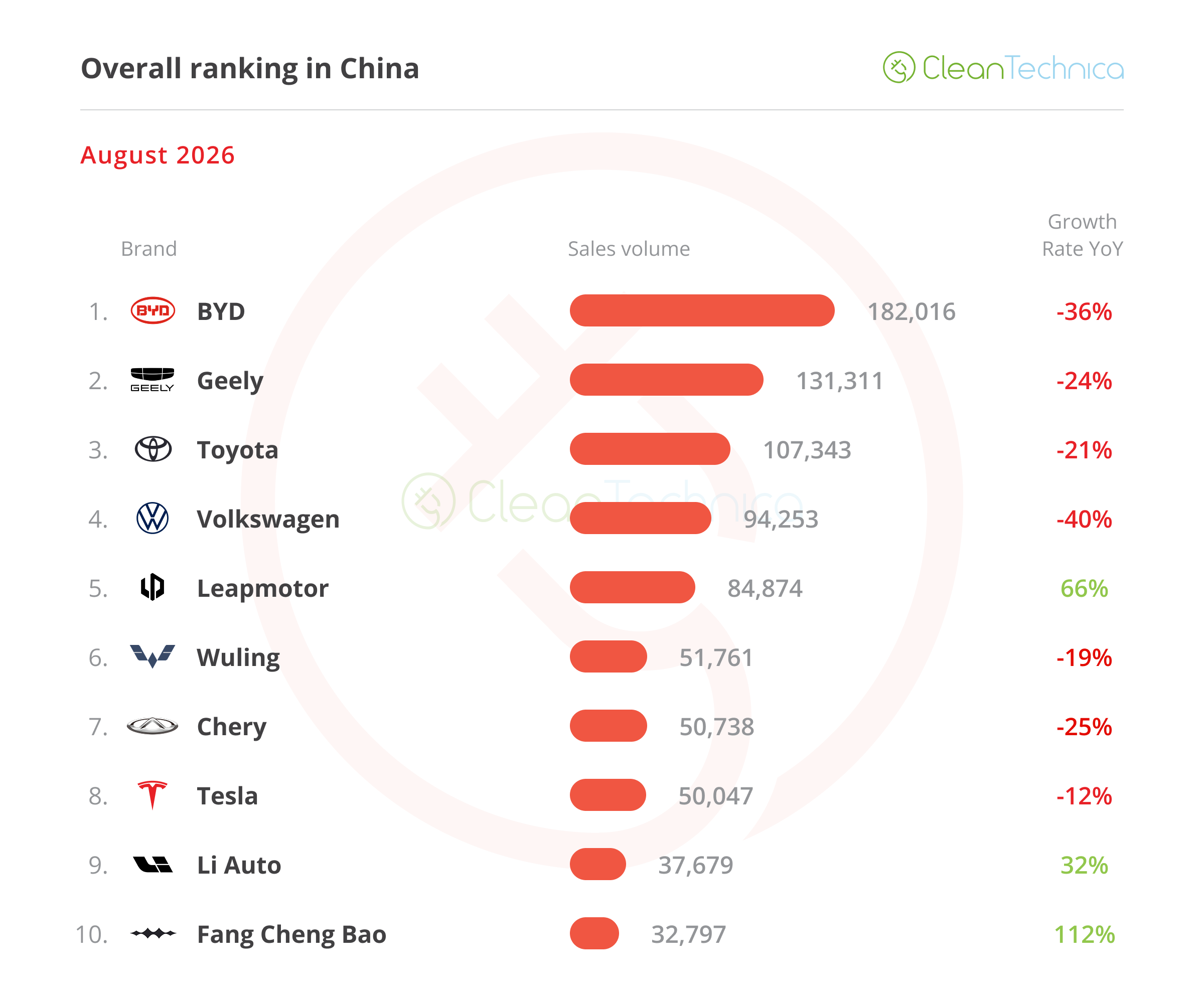
Sales fell across the leading manufacturers in August, though the scale varied. Toyota was down 21% year over year; BYD fell 36%, Geely 24%, and Volkswagen 40%. Volkswagen was fourth in the monthly ranking. Against those declines, Leapmotor rose 66% to 84,874 registrations, setting another record and finishing fewer than 10,000 units behind Volkswagen.
Leapmotor’s pipeline includes the A10 and A05 as they scale up, along with the D19 and D99. That gives the brand room to compete across a broader spread of vehicle sizes. Its small-car models also put pressure directly on Geely: if the A10 and A05 take meaningful sales from the Xingyuan, the effects could reach beyond individual model rankings and alter the brands’ relative positions.
NIO also recorded strong year-over-year growth, with sales up 104% to 21,000 units and the brand at 24th. The source credits demand for its ES8 and ES9 large SUVs. It lists starting prices of $57,000 for the ES8 and $73,000 for the ES9, putting NIO’s average selling price at around $65,000.
Japanese brands faced steep declines. Honda ranked 18th in August after sales fell 50% year over year to 27,000 units. Nissan dropped 55% to 24,000, placing 21st. These results underline the widening gap between established international manufacturers and Chinese brands in an increasingly electric market.
Leapmotor closes in on the leaders
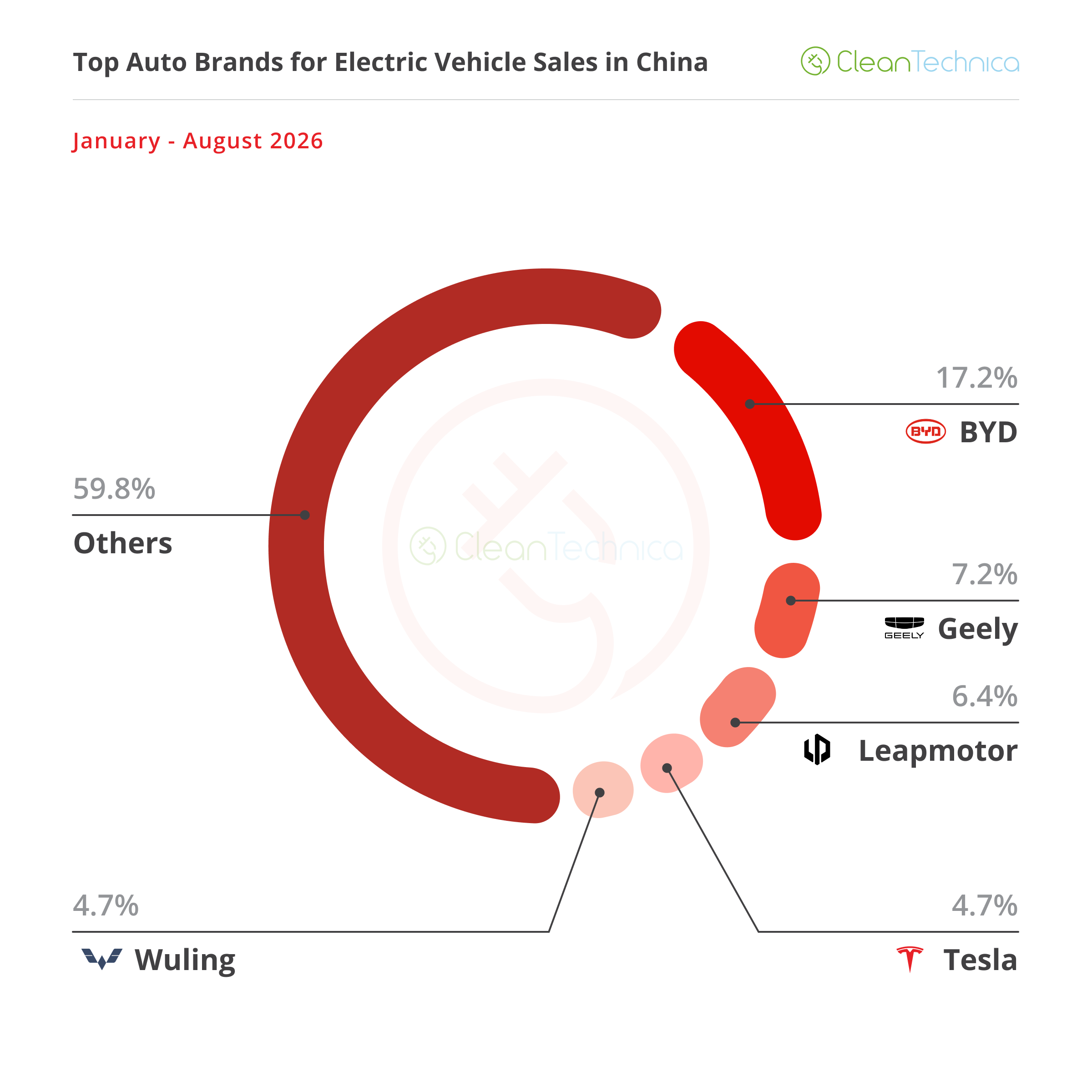
BYD remained China’s leading brand, with 17.2% share, up 0.1 percentage point. Geely held second at 7.2%. Leapmotor reached 6.4%, gaining 0.3 percentage point and moving closer to Geely. Tesla retained fourth place at 4.7%, level with Wuling, which the report identifies as a potential challenger. It expects Tesla’s typically strong September to help the brand maintain its position.
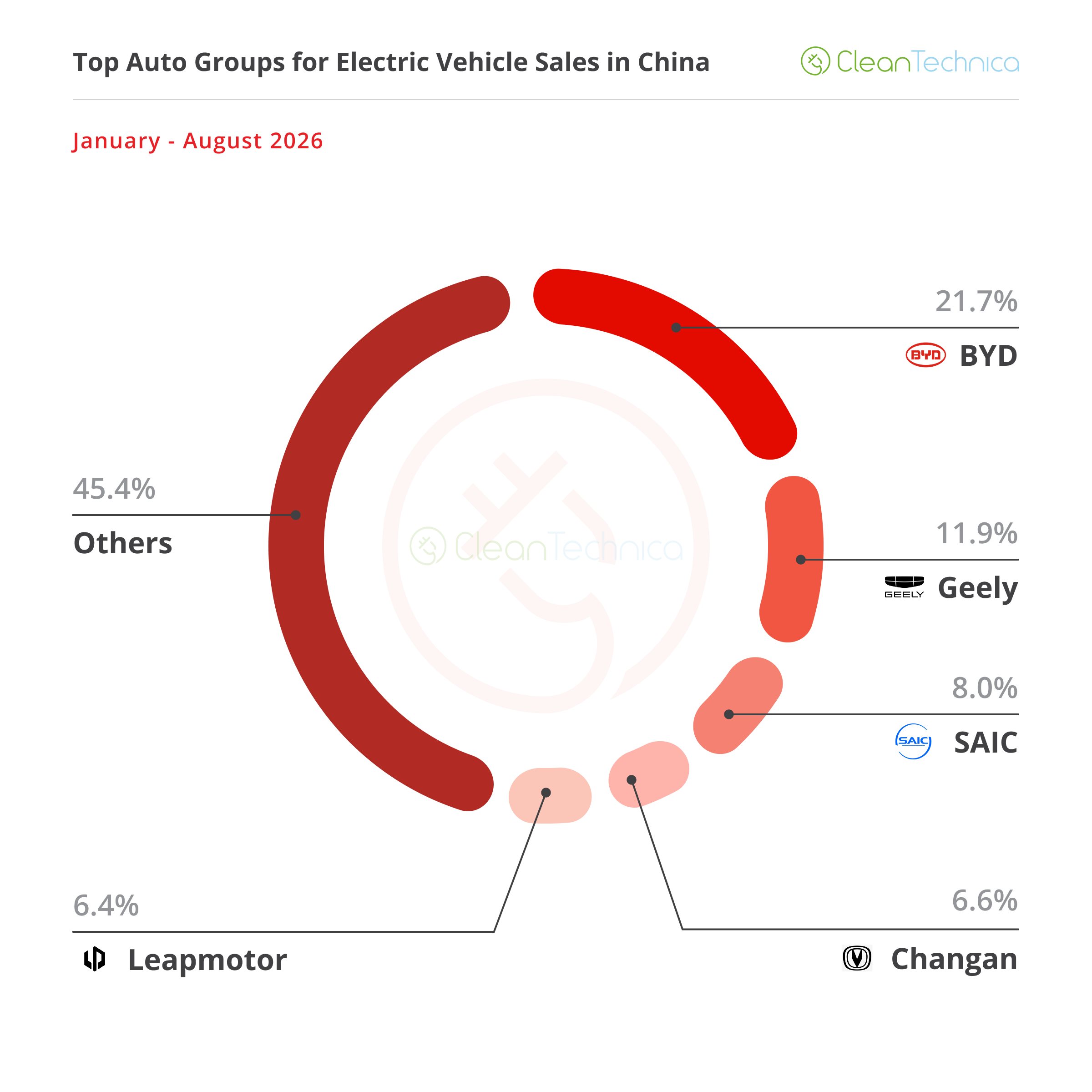
At the broader automaker-group level, BYD led with 21.7% share, up 0.3 point, supported by Fang Cheng Bao and a strong month from Denza. Geely was second at 11.9%, down 0.2 point. SAIC held third at 8%, compared with 8.1% in July, and Changan stayed fourth at 6.6%, down 0.1 point. Leapmotor ranked fifth at 6.4%, up 0.3 point, and is closing in on Changan.
The report attributes Leapmotor’s rapid rise to a lineup that spans city cars through full-size models without splitting every category among numerous closely related vehicles. Its next step is a second brand in China, expected later in 2026, as described in a linked report on the company’s plans. Whether that move can extend its reach while keeping its core value proposition intact remains an open question. For now, the A10 and A05 offer the clearest test: they’re arriving in the market’s hottest segment, where Geely’s Xingyuan has set the pace and rivals are multiplying.