In lane Electric Vehicles
Uruguay EV Sales Reach 56% of New-Vehicle Market as August Sets Record
Description
EVs took 56% of Uruguay’s August sales, including a 51% share for BEVs. BYD leads year to date, while Geely’s EX2 topped the month.
Uruguay’s electric-vehicle shift has moved beyond early adoption: EVs accounted for 56% of new-vehicle sales in August 2026, with battery-electric models alone taking 51%. That means fully electric cars made up roughly one in every two vehicles sold in the month, a striking result in a region where adoption has generally lagged.
The change has come quickly. Uruguay’s BEV share rose from 5% to 50% in about two and a half years, and EV sales set a monthly record in six of the first eight months of 2026. August’s figures suggest the shift is not simply a niche trend, even as the market’s rapid growth raises questions about how quickly it can continue.
August’s record and the powertrain split
EV sales climbed 171% year over year in August, nearing 4,000 units. The total was 22% higher than the previous record, set in July. Plug-in hybrids are now included in the sales tally, but remain a small part of the mix: they account for around one-tenth of EV sales. Uruguay’s market is therefore still strongly weighted toward fully electric vehicles.

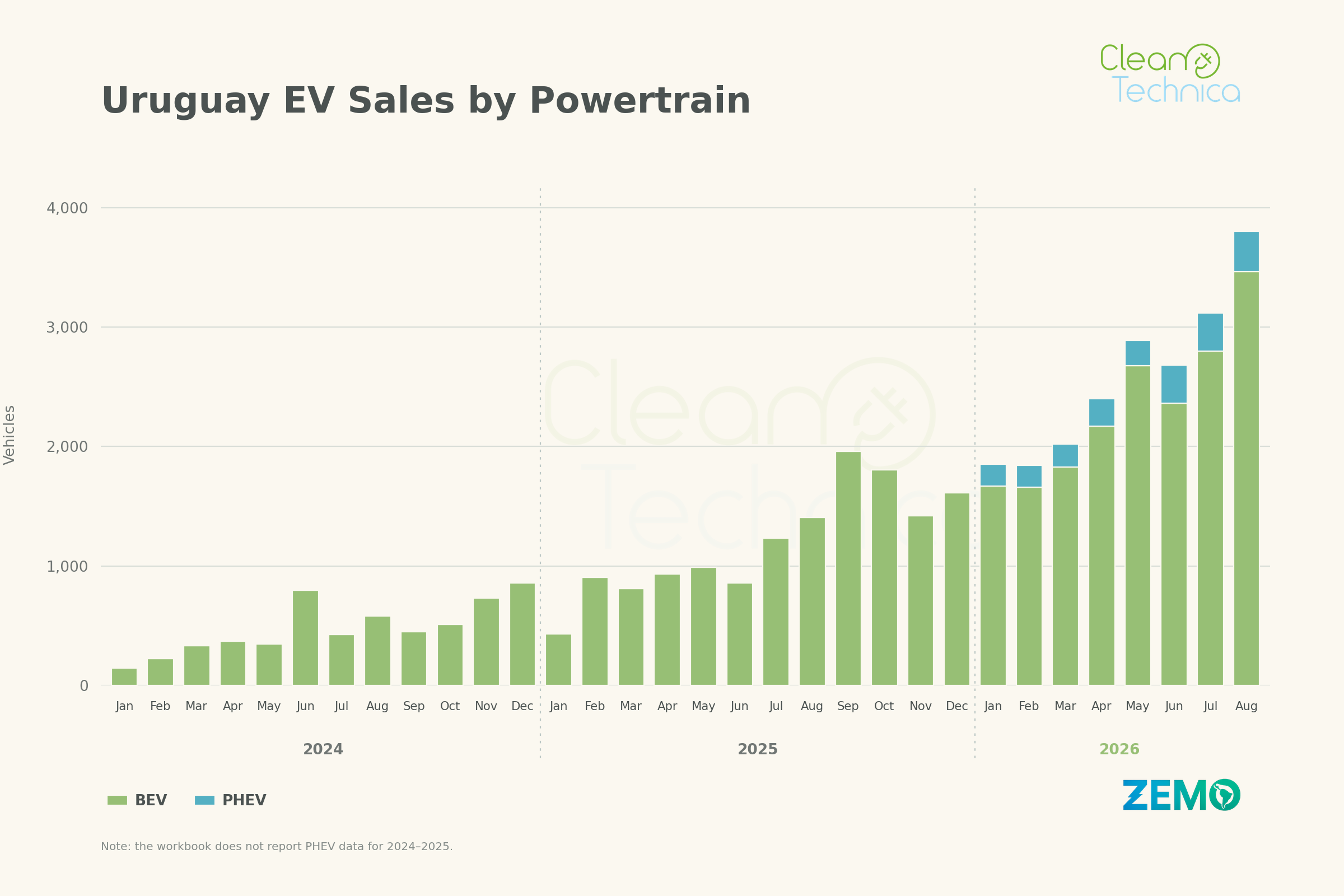
The broader vehicle market is growing too, but not at the same pace. Total sales increased 16% from January through August compared with the same period in 2025. Despite that expansion, sales of combustion-powered vehicles, including hybrids, fell 16% over the year to date and were down 20% from 2024. The figures point to a change in the mix of vehicles buyers are choosing, rather than a contraction in the market overall.



BYD leads overall, but Geely wins August
Competition among EV brands remains comparatively balanced. BYD held first place in August with 25% of sales, followed by Geely and GAC. That leaves room for rivals to make a mark even as BYD retains the strongest position. Tesla has announced competitive pricing but had not begun deliveries in Uruguay at the time covered by the figures, so it was not yet part of the sales contest.
At the model level, Geely’s Geome/EX2 led in August, ahead of the BYD Seagull and GAC Aion UT. The EX2’s monthly result is notable alongside its fourth-place year-to-date standing: it arrived in Uruguay only recently, yet has already entered the top group. The Aion UT, meanwhile, adds another contender to a market where the leading positions are not confined to a single manufacturer.
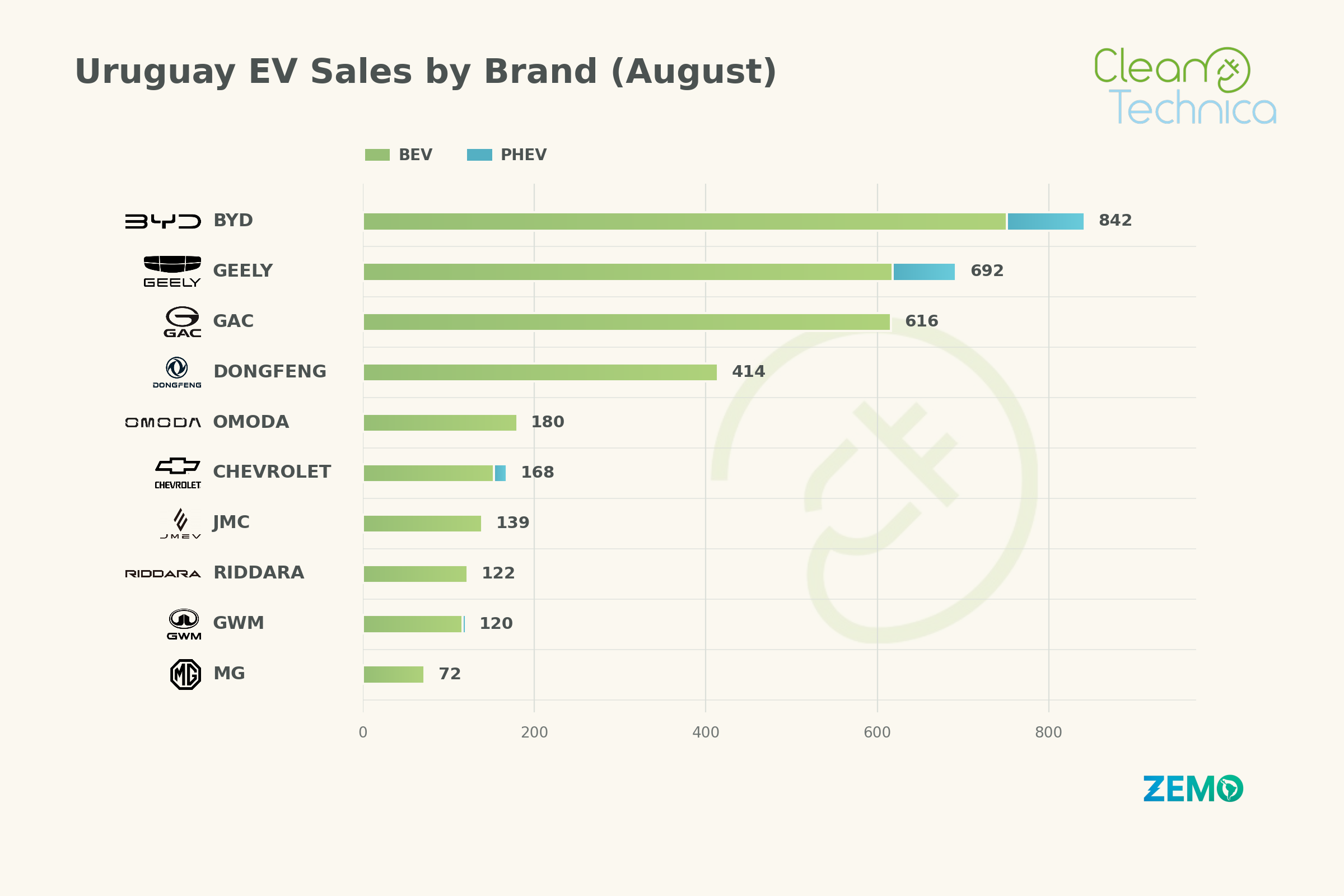


The year-to-date rankings tell a different story from August’s monthly result. BYD leads the brand table, with Geely second and Dongfeng third. GAC sits fourth, followed by Chevrolet in fifth. Chevrolet is the only established non-Chinese automaker in the top 10, with its position supported by models sold under the Spark EUV and Captiva EV names, based on the Baojun Yep Plus and Wuling Starlight S, respectively.
BYD also holds the top two model positions year to date. The Yuan Up, which now includes a plug-in hybrid version, leads the list, followed by the Seagull. Dongfeng’s Nammi ranks third, with Geely’s EX2 fourth and the Spark EUV fifth. That mix shows how value-focused models from Chinese brands are shaping the sales table, while the EX2’s quick climb signals that newer arrivals can gain traction rapidly.


What could shape the next phase
Uruguay’s high gasoline prices provide a clear reason for buyers to consider electric models, but fuel costs alone may not explain the pace of the recent surge. Prices have risen only 11–13% since September 2023, according to the source, while EV adoption has accelerated sharply. The more straightforward explanation may be that buyers increasingly see electric vehicles as better value against the available alternatives.
A new tax schedule for EVs is due to begin in 2027. Vehicles imported at prices from USD$19,001 to $27,000 will face a 5% internal tax, while those priced above $27,001 will be charged 9%. Cheaper EVs will remain exempt. The rates are described as low compared with those applied to combustion vehicles, which can reach 35%.
The change could encourage some buyers to purchase before the new charges take effect. But the relatively limited rates make a major sales slump in 2028 seem less likely; a slower growth rate is a more plausible outcome. Once EVs already exceed half the market, the exceptional growth rates seen during the transition’s earlier stages are harder to maintain.
Uruguay’s BEV share places it below Norway, Sweden, Denmark, Ethiopia and Nepal, but above China, the Netherlands, Belgium and the UK, according to the source’s comparison. The more important signal may be the pace of change: electric models are taking sales from combustion vehicles in a market that is still expanding.
Tesla deliveries have yet to begin, adding another potential source of competition. The source points to Tesla’s impact in Colombia at prices of $30,000 or less as a comparison, though Uruguay’s market already has a strong set of rivals. The next measure to watch is whether combustion-powered models continue losing ground as more EV choices arrive and the market adjusts to the 2027 tax changes.


