In lane Electric Vehicles
Europe EV Sales: BEVs Reach 30% Share as Chinese PHEVs Surge
Description
Europe registered about 250,000 BEVs in August, while Chinese-built plug-in hybrids gained ground and new models reshaped the rankings.

Europe’s August EV figures point to two shifts worth watching: battery electric vehicles are gaining share even in the seasonal slowdown, and Chinese-built plug-in hybrids are expanding much faster than their European-made rivals. About 250,000 BEVs were registered during the month, a 51% year-on-year increase and the fastest growth rate recorded so far in 2026.
BEVs accounted for a record 30% of the market in August. Plug-in vehicles as a whole reached 42%, up 39% year on year, with plug-in hybrids contributing 98,000 registrations and growing 15%. That was their slowest annual growth in 18 months. The contrast suggests that the current expansion in plug-ins is being led increasingly by fully electric models.
August and July are often quieter months for European vehicle production and sales as manufacturers and customers take summer breaks. Models with strong demand can benefit from that lull: factories may prioritize them, helping to shorten waiting lists. The scale of August’s BEV increase suggests that the market’s momentum extends beyond the usual seasonal pattern.
BEVs pull ahead as other powertrains lose ground
For the year to date, BEVs hold 24% of the market, while BEVs and plug-in hybrids combined account for 35%. Both figures are already above the full-year 2025 results: 20% for BEVs and 29% for all plug-ins. If the trend continues, Europe’s transition toward an almost entirely plug-in market by the mid-2030s looks more plausible, although August alone can’t establish the pace of that change.
Petrol vehicles held 18% of August sales, down 24% year on year, and diesel took 6%, down 23%. Conventional hybrids, which can’t be plugged in, still grew 3%, slightly slower than the overall market. Their share slipped to 32% from 33% a year earlier. That small decline raises the possibility that conventional hybrids have reached their high point, but a longer run of results will be needed to confirm it.
The next question is whether plug-in hybrids will follow the same path. For now, the category is still growing, but the origin of those vehicles is changing quickly. That distinction matters to established European makers, which are seeing a much sharper challenge in PHEVs than in BEVs.
Chinese-made PHEVs take a larger slice
The sales mix by production origin has moved in different directions for BEVs and PHEVs. Chinese-made BEVs increased in volume after import duties were introduced in the second half of 2024, but their market share stayed broadly around its previous level as the overall BEV market also expanded. They represented 21% of European BEV sales in the comparison cited by the report.

Chinese-made PHEVs have grown far faster. They accounted for 10% of Europe’s PHEV market in 2024; they now represent 28%, more than the Chinese share of BEV sales. The report attributes much of that change to different treatment of the two vehicle types: Chinese BEVs faced additional duties, while PHEVs continued to pay the original 10% rate.
Chinese manufacturers have responded with a broader range of plug-in hybrids, including the BYD Atto 2 PHEV, Geely Starray, Jaecoo 7 PHEV and Omoda 9. In 2026, Chinese-made PHEV sales are up 141%, against 24% growth for the overall PHEV category. PHEVs made in Europe have risen just 3% this year, with sales falling in three of the past four months.
That gap points to a competitive problem for European brands: customers aren’t leaving plug-in hybrids as a category; many are choosing alternatives made in China. Whether European manufacturers can respond with fresh models, more competitive prices or both will help determine how much of the PHEV market they retain.


Model leaders show the breadth of demand
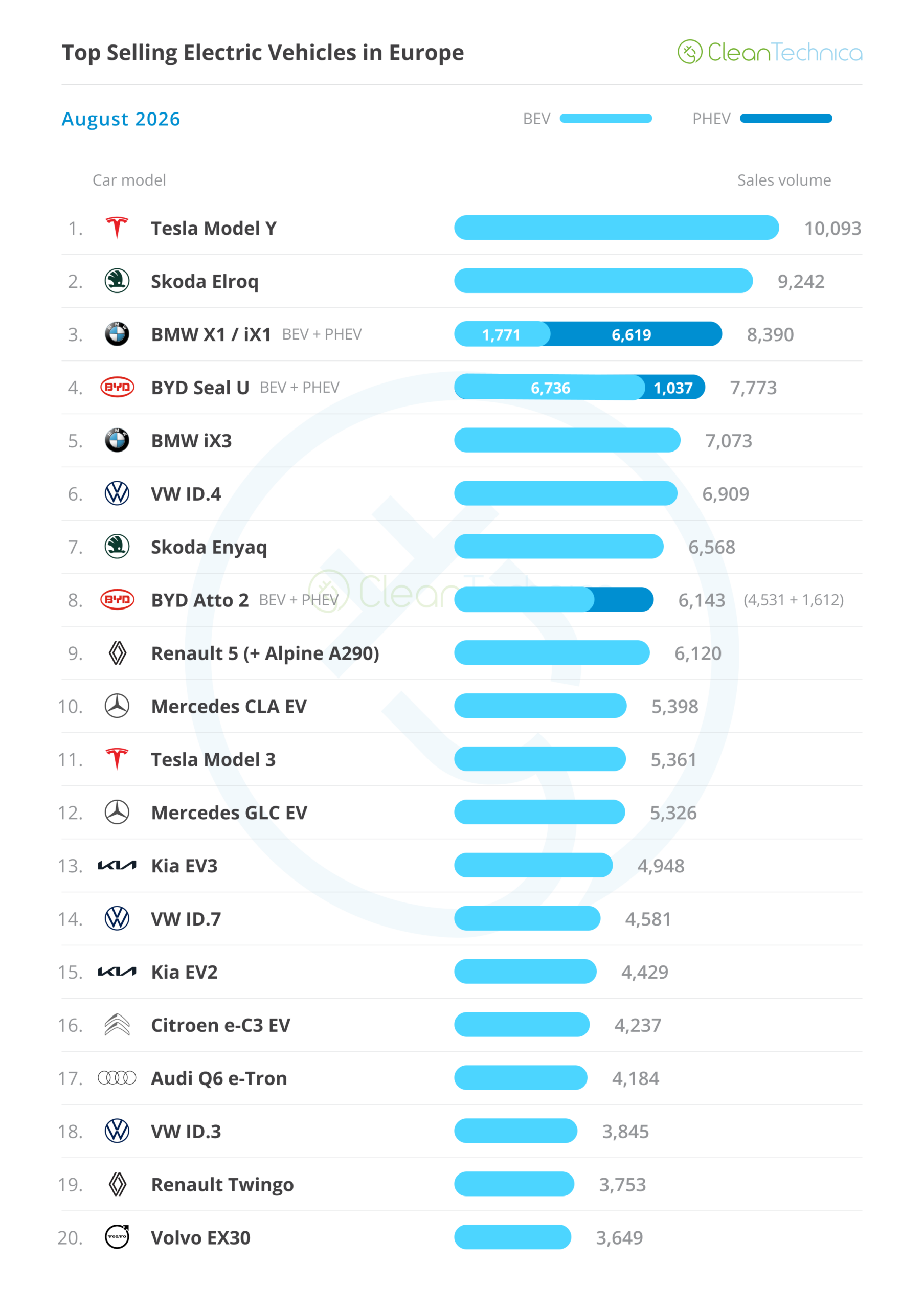
The Tesla Model Y returned to the top of August’s model rankings with 10,093 registrations, up 21% year on year. Starting prices were reported at €40,000. Six years after its arrival, it continues to attract buyers looking for a practical electric crossover and lower running costs than a combustion vehicle. Its popularity with ride-hailing drivers also reflects that cost-focused appeal.

The Skoda Elroq placed second, with 9,242 registrations, a 45% annual increase. Its next test will come from within the Skoda range: the smaller, more affordable Epiq is due to arrive. The new model could widen the brand’s reach, though it may also compete for customers who might otherwise choose an Elroq.
Third place went to the BMW iX1 and X1 PHEV together, with 8,390 registrations. Favorable lease rates have supported the compact crossovers, which are central to BMW’s European sales. A substantial refresh of the brand’s compact models is expected to bring updated specifications and design cues from the Neue Klasse electric family. The iX1’s performance in particular will show whether BMW can keep the range competitive as new alternatives arrive.
The BYD Seal U, counting BEV and PHEV versions, ranked fourth with 7,773 registrations. Discounts helped lift the model’s August result. Its strong showing also reflects the room manufacturers have to price established vehicles aggressively once development costs are largely behind them.
BMW’s new iX3 completed the top five with 7,073 registrations, making it the highest-ranked BEV from a European manufacturer. The report lists a 108 kWh battery, charging at up to 400 kW and vehicle-to-everything capability among its specifications. It also points to the model’s range, efficiency, handling and cabin as part of its appeal. These details give the iX3 a strong position against premium electric SUVs, though buyers will want to compare the final specification and price of the versions available to them.
New entries and production ramps
Mercedes placed the CLA EV tenth with 5,398 registrations. The new GLC EV reached twelfth, recording 5,326 registrations, a monthly high for the model. Its sales could rise further as production develops. The GLC’s cabin and styling may appeal to buyers, while its specifications were described as a step below the BMW iX3’s. The coming months should make the comparison between the two premium SUVs clearer.

Kia’s EV3 stayed in the top 20 at thirteenth. The smaller EV2 also entered the ranking for the first time, with 4,237 units. Production is still ramping up, and the report describes a substantial waiting list. If the factory can meet demand, the compact crossover could become Kia’s best-selling model in Europe.
Citroën delivered 4,237 C3 EVs, its strongest result in five months and enough to return the model to the top 20. The result gives Stellantis a welcome high-volume entry. The report also points to the planned 2027 Peugeot 208 EV as another possible source of momentum for the group.
Just outside the top 20, the Cupra Raval recorded 3,608 units and finished 21st as production ramped up. Volkswagen’s ID.Polo made its debut with 1,876 deliveries. The report says the new model has a waiting list of up to 10 months. Its initial demand, alongside weaker orders for Volkswagen combustion models, puts pressure on the company to ensure production can keep pace.
Year-to-date rankings remain in motion
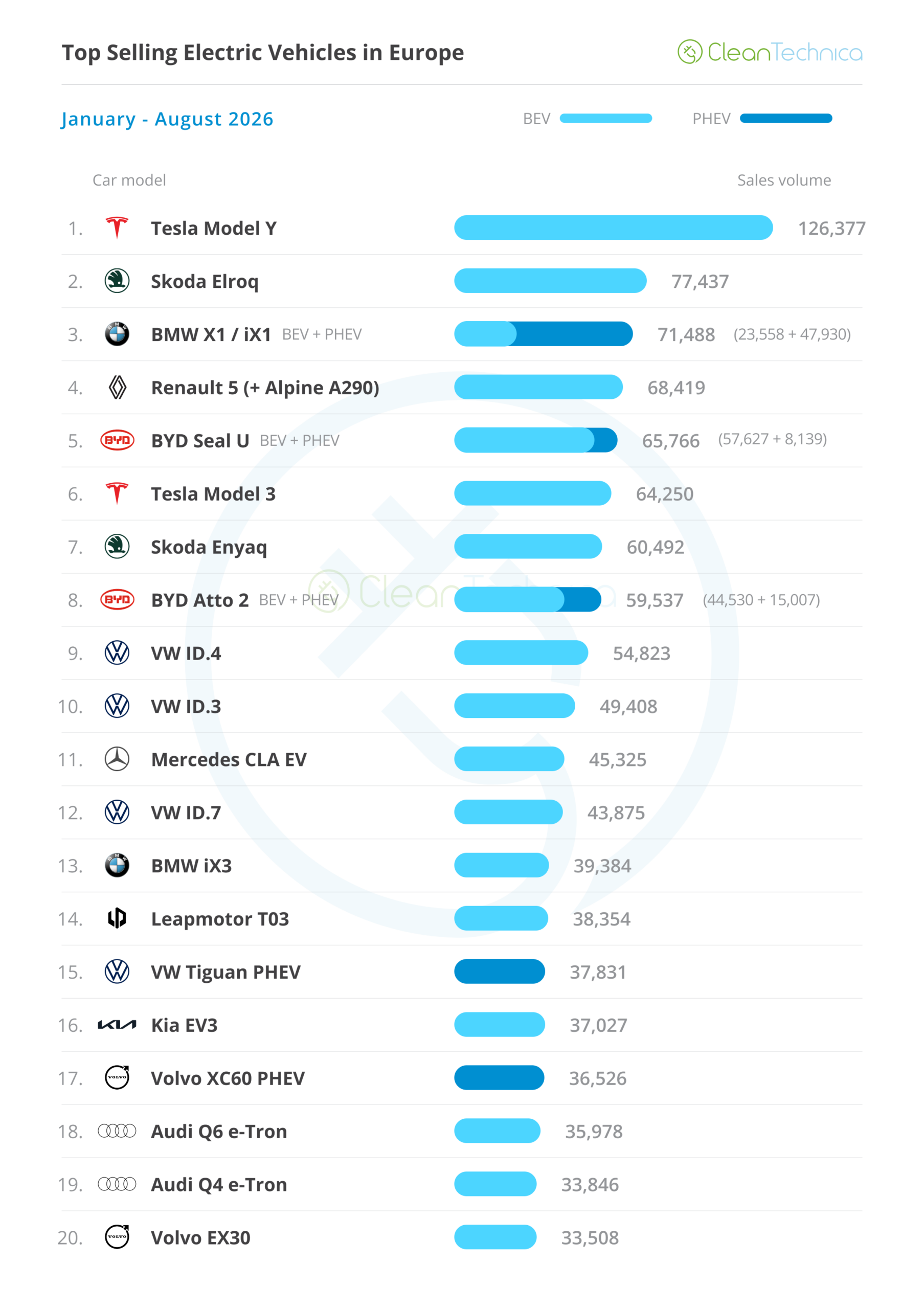
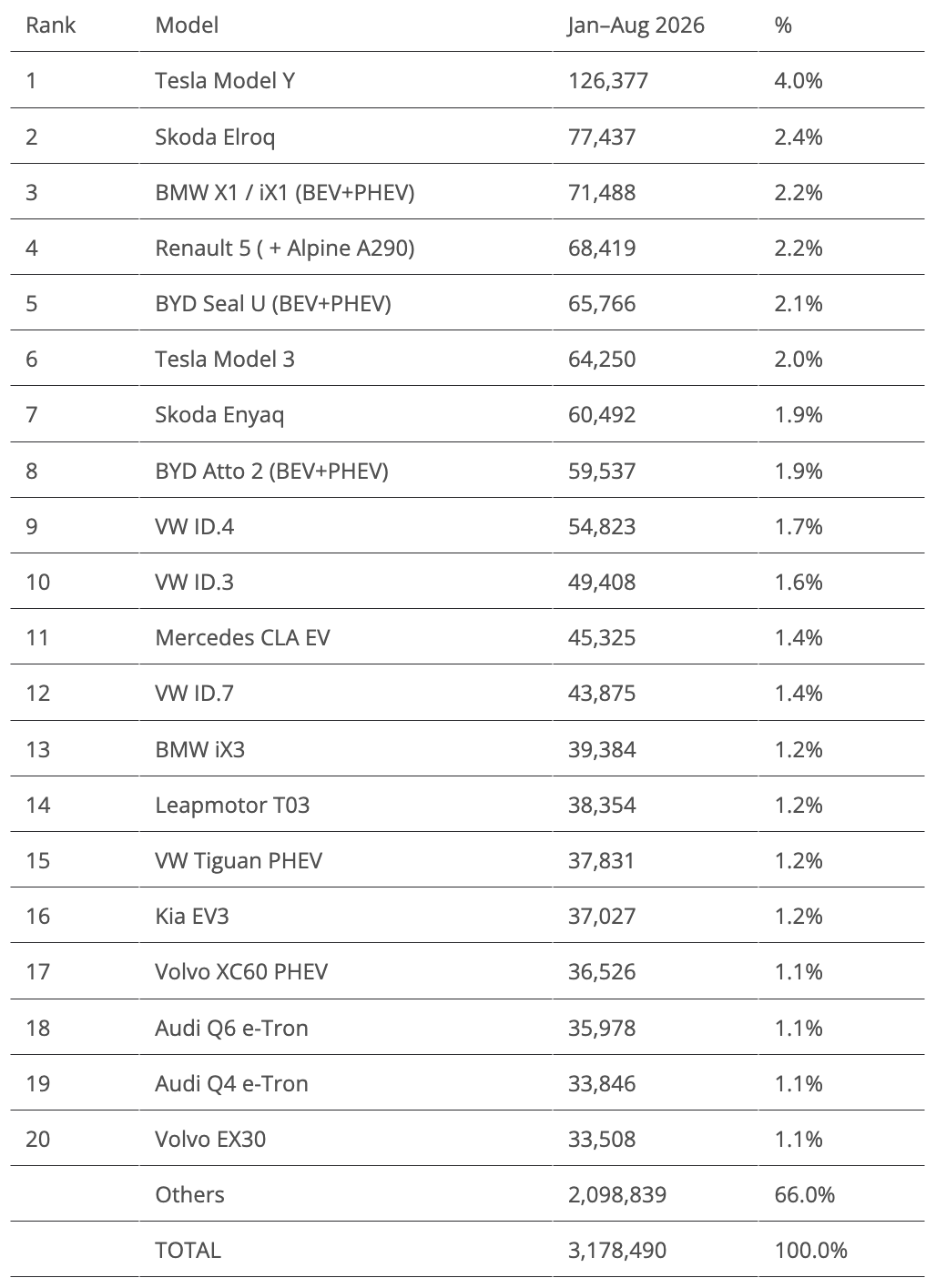
The BYD Seal U moved ahead of the Tesla Model 3 to take fifth place in the January-to-August ranking, pushing the sedan to sixth. The Skoda Elroq’s second-place position looks harder to challenge, while the Model 3 may still contend for third or fourth as quarterly sales patterns play out. The BMW iX1 and X1 PHEV have been consistent contenders for third; the Renault 5 is also in the mix for fourth.
The iX3 gained three places to reach thirteenth year to date. The Kia EV3 advanced to sixteenth after a weaker month for the Volvo XC60 PHEV. If PHEV sales remain subdued, the EV3 could close in on the VW Tiguan PHEV and the Leapmotor T03, which holds fourteenth.
Brand and group standings expose a widening contest
Kia ranked seventh among brands with 36,810 units, up 16% year on year. Hyundai was twelfth with 26,186, down 30%. BYD reached thirteenth with 26,090 units, ahead of Opel, Citroën and Tesla, which stood nineteenth. The contrast between Kia and Hyundai shows how uneven results can be within a single group.
Chinese brands now occupy 15 of the top 50 positions. Among the fastest growers were Xpeng, up 323% at thirty-first; Leapmotor, up 222% at twenty-ninth; Jaecoo, up 191% at twenty-fourth; and Omoda, up 129% at twenty-seventh. Europe’s overall market grew 5% year on year, with Chinese makers contributing to that expansion.
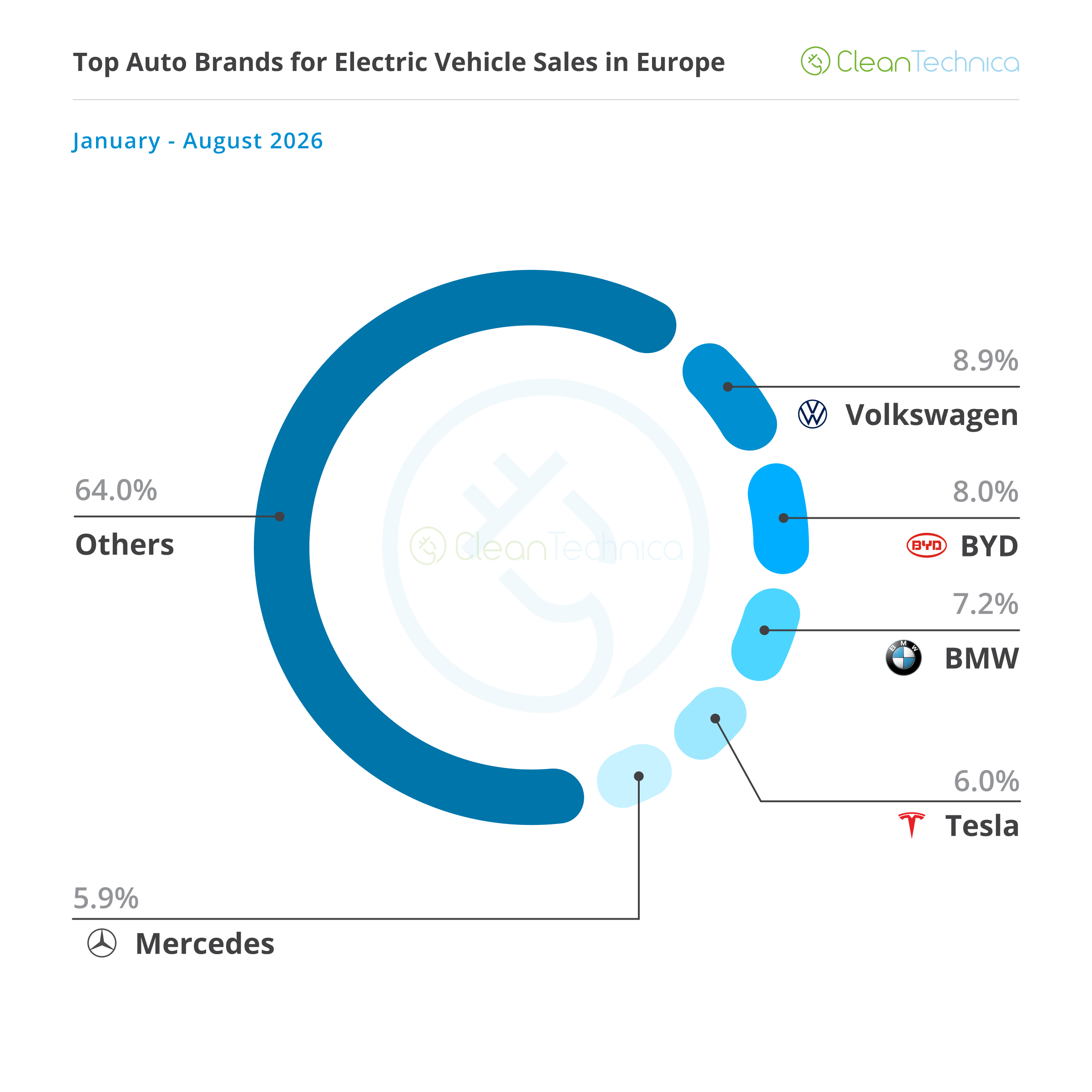
In the plug-in brand rankings, Volkswagen remained first with an 8.9% share, down from 9% in July and 9.3% in May. BYD rose to 8%, while BMW held third at 7.2%. Tesla’s share slipped to 6%, leaving BMW positioned to finish the quarter ahead. Mercedes held fifth at 5.9%, followed by Audi at 5.4% and Skoda at 5.3%.
Volkswagen’s upcoming ID.Polo, ID.Cross and ID.Tiguan could help refresh its offering, but the brand’s lead is narrowing as BYD grows. BMW’s position also faces a test: it remains a strong contender, but BYD is now close enough to make the race for second place a central story in the rankings.
By automotive group, Volkswagen Group led with a 23.9% share. BMW Group followed at 8.7%, with Stellantis third at 8.1%, down 0.1 percentage point. BYD was close behind at 8%, up 0.1 point. If the two groups’ recent directions continue, BYD could challenge Stellantis for third place as soon as September.
Hyundai–Kia held 7.5%, ahead of Geely at 6.8%. Renault–Nissan, in seventh, is close enough to make the contest for sixth worth following. The August figures therefore capture more than a strong BEV month: they show Chinese manufacturers gaining ground across powertrains, while European groups face pressure to convert new-model launches into sustained volume.



