In lane Electric Vehicles
Global EV Sales Reach 27% in August as Small Models Gain Ground
Description
August plugin registrations rose 5% year on year, with battery EVs making up 73% of sales. Geely’s Xingyuan took second place behind the Tesla Model Y.


Small electric cars and a changing mix of manufacturers shaped the global market in August. Plugin vehicle registrations reached about 1.8 million, up 5% year on year, while battery electric vehicles (BEVs) advanced and plugin hybrids (PHEVs) lost ground. In the model rankings, Geely’s Xingyuan set a record and moved into second place behind the Tesla Model Y. The figures point to a market where compact, lower-cost EVs are taking a larger role alongside established leaders.
Battery electrics drive plugin growth
BEV registrations climbed 13% year on year in August, while PHEV registrations fell 12%. Across the year to date, plugin sales were up just 4%, a result shaped by an 11% drop in PHEVs even as BEVs grew 12%. BEVs accounted for 73% of August’s plugin sales, or about 1.3 million vehicles. Their year-to-date portion stood at 71%, the highest since 2022, when it reached 72%.
Regional patterns differ. China’s PHEV market has weakened sharply, while US EV sales have been adjusting to the end of a tax credit and changes in the market. Outside China and the United States, plugin sales rose 53% year on year in July, with BEVs up 62%. The distinction matters when reading the global total: it combines markets moving at different speeds and with different mixes of battery electric and hybrid vehicles.
BEVs held 20% of the global vehicle market in August. Including PHEVs brings the month’s plugin share to 27%. For 2026 to date, BEVs have a 17% share and PHEVs 7%, putting plugins at 24%. Add conventional hybrids, which accounted for 15%, and 39% of vehicles sold worldwide this year have some form of electrification.
Geely’s Xingyuan rises to second
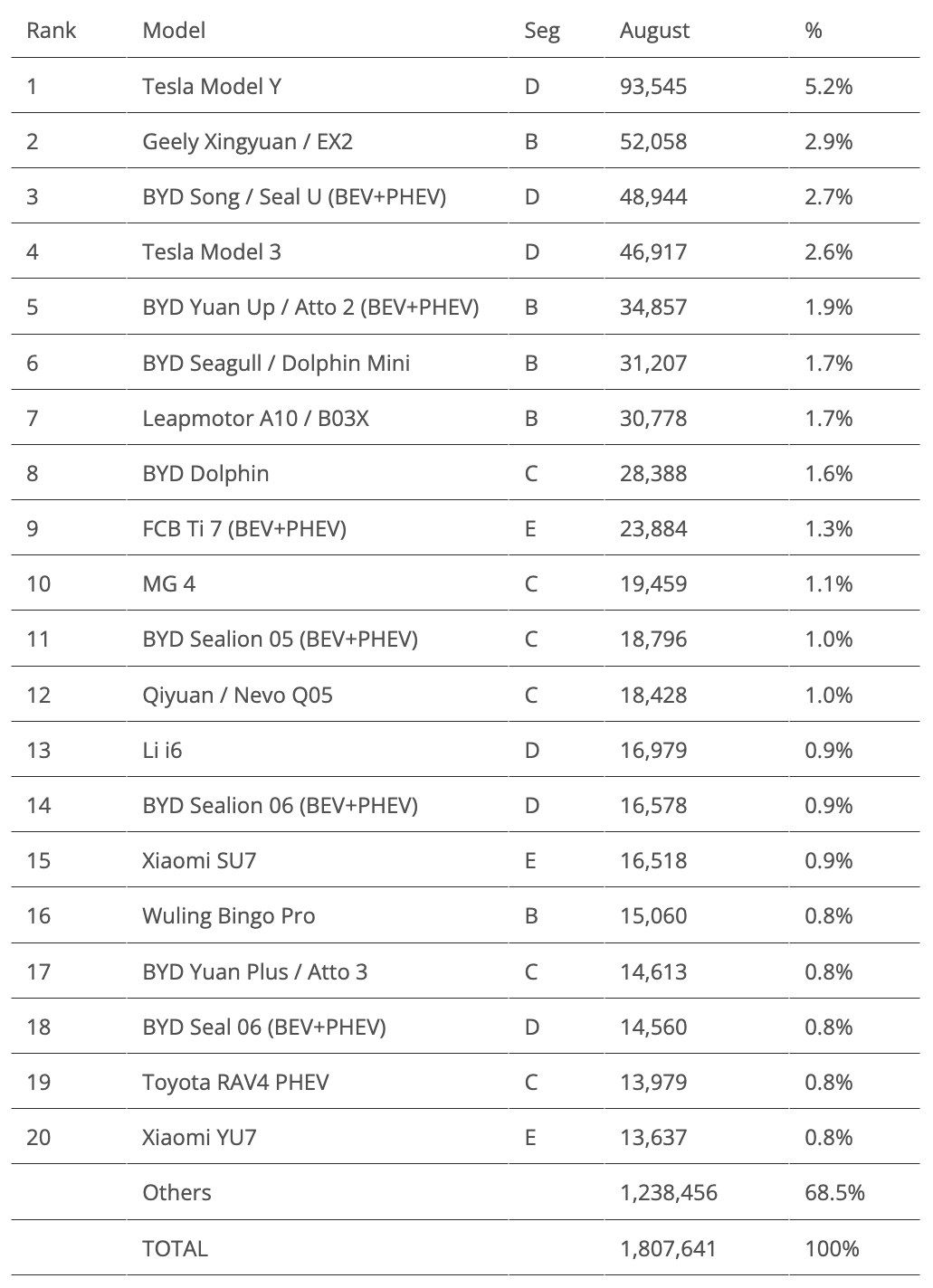
The Tesla Model Y remained the world’s best-selling plugin model in August, although its deliveries fell 12% year on year. The biggest move beneath it came from Geely’s Xingyuan, also known as the E2 or EX2 in export markets. A record 52,058 registrations, supported by strong domestic demand and growing exports, lifted the small hatchback into second place ahead of the BYD Song.
Export volumes included 5,804 registrations in Brazil, 1,279 in Australia, 1,595 in Indonesia and 1,770 in Thailand. Those numbers show how quickly a high-volume compact car can build a presence beyond its home market. Geely’s challenge will be to turn the Xingyuan’s momentum into a broader lineup of strong sellers; the report raises questions about potential additions, including an electric midsize SUV and a crossover version of the hatchback.
The BYD Song placed third with 48,944 registrations, up 21% year on year. Exports contributed, including 6,724 registrations in Brazil, 1,477 in Italy and 1,466 in Germany. The new-generation Ultra body also added to its appeal. Flash charging is expected to support the model’s sales, though the report’s forecast that the Song could challenge the Model Y in some quieter months remains a possibility rather than a settled trend.
Several small EVs filled the next positions in the monthly table: BYD’s Yuan Up, sold as the Atto 2 in some markets; the BYD Seagull, which has several export-market names; Leapmotor’s A10, known as the B03X outside China; and the BYD Dolphin. The concentration of compact models near the top is a notable shift in a ranking often associated with larger crossovers and sedans. Their smaller size can help with efficiency, while broader availability gives more buyers an entry point into electric driving.
The Seagull recorded 31,000 registrations, its best month of the year, with exports making a substantial contribution. It registered 5,560 units in Indonesia and 8,299 in Brazil, compared with 10,103 at home. The Dolphin reached 28,388, its strongest result since December 2023. Brazil alone accounted for 6,740, far ahead of its next-largest export market, South Korea, at 1,202.
Leapmotor’s A10 is another model to watch. Production is still ramping up, and exports are expected to begin soon. Its August position reflects a fast start, though its eventual standing will depend on how quickly the company can build output and establish sales overseas. The new-generation Wuling Bingo Pro also made progress, with roughly 15,000 registrations, the nameplate’s best result in 15 months.
Toyota’s plugin range returns to the rankings
BYD’s Fang Cheng Bao Ti 7 placed ninth with nearly 24,000 registrations, a year-best result for the large crossover. The result gives BYD’s premium marque a strong domestic foothold. Whether it can translate that performance into export volume remains an open question, and could put it in more direct competition with established SUV names such as Land Rover, Toyota and Jeep.
A different kind of return came from Toyota’s RAV4 PHEV. The new generation re-entered the top 20 in 19th place, with close to 14,000 registrations following a wider rollout. That is almost twice the previous generation’s peak. The result suggests the plug-in RAV4 could become Toyota’s leading plugin model, moving ahead of the all-electric bZ4X in the company’s lineup.
The RAV4’s broader market position adds context: it was the world’s best-selling vehicle overall in 2024, but now ranks fifth in the overall market. The PHEV’s stronger showing is one sign that electrified versions are increasingly relevant to a model’s standing across the wider market. Toyota’s Hilux EV, by contrast, remains at the start of its volume ramp. It recorded 1,038 deliveries worldwide in August, well short of the BYD Shark, which averages about 3,500 registrations per month. The Hilux’s progress will depend partly on how much Toyota prioritizes its battery version alongside combustion models.

Outside the top 20, Chery’s QQ3 EV reached 12,579 deliveries as production expanded. It follows a similar small-car approach to the Xingyuan, and could enter the leading group if output and demand continue to rise. These models make the compact segment an increasingly important part of the global sales picture.
Model leaders through August
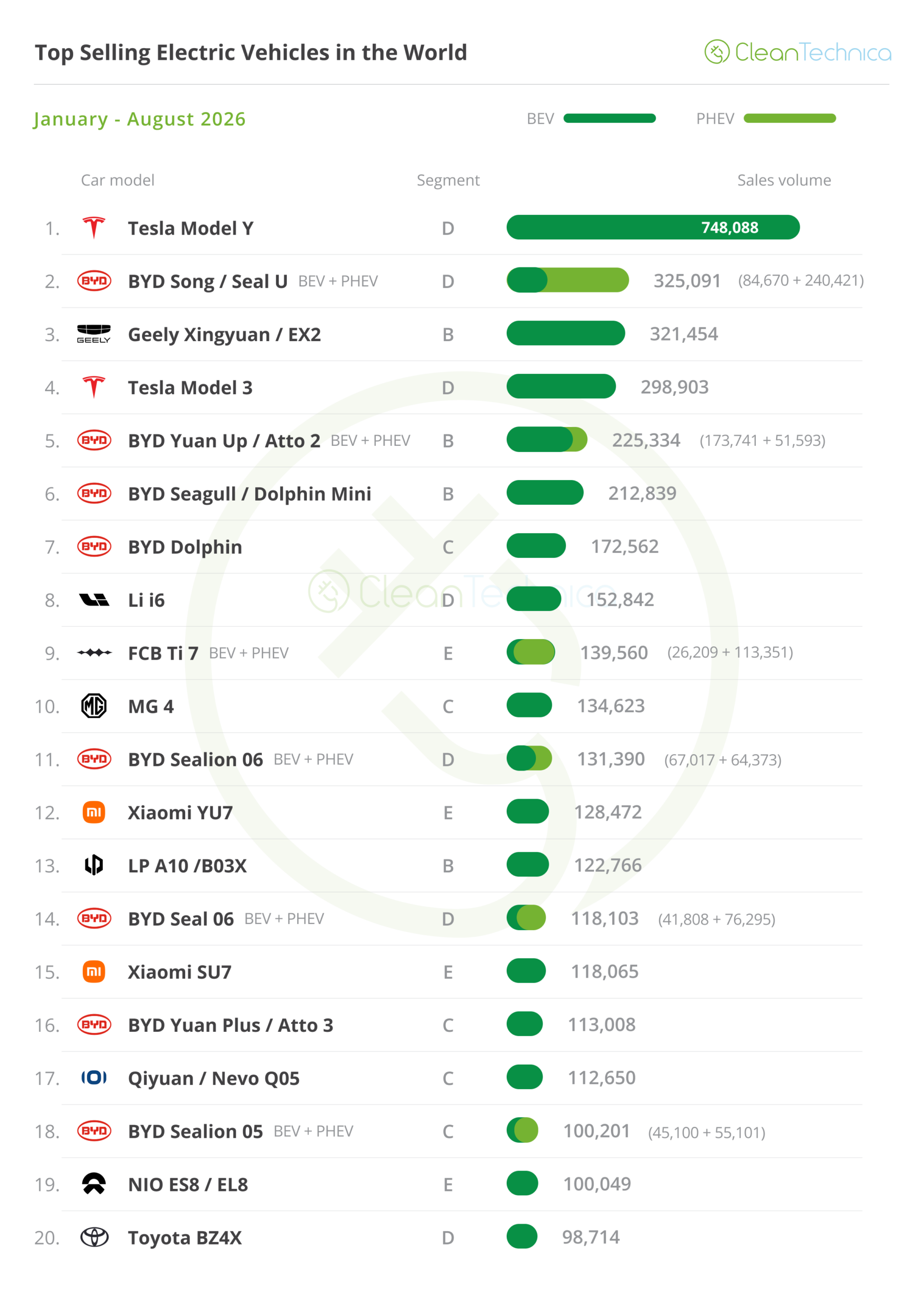
For the year to date, the Model Y holds a clear lead, selling about twice as many units as the BYD Song. Geely’s Xingyuan is third and sits roughly 3,500 units behind the Song, leaving the runner-up position within reach. The Model 3 could also become part of the contest after a strong September, although the report expects the Song to retain second, followed by the Xingyuan and then the Model 3.
That would keep the second and third positions unsettled into the final quarter. The Model 3 has appeared on the annual podium every year since 2018; the Xingyuan has yet to finish among the top three. A close race would give the rest of the year a useful measure of whether a new compact entrant can sustain its rapid rise against established nameplates.
Further down the year-to-date table, BYD’s Sealion 06 moved up to 11th, while the smaller Sealion 05 entered in 18th. Leapmotor’s A10 gained four places to 13th. Its production ramp and planned export push could bring another climb, though the scale of that increase will become clearer as more months of data arrive.
Among EVs made outside China, Tesla’s Model Y and Model 3 took the top two places. Their trends diverged: the Model 3 was down 16% year to date, while the Model Y was up 14%. The report attributes the latter’s growth to higher output from Tesla’s German factory, which more than offset weaker sales in the company’s home market.
The rest of this non-China top five has changed from last year. Toyota’s bZ4X ranked third, followed by BMW’s iX1 and X1 PHEV, with the Skoda Elroq fifth. The bZ4X’s sales and production were up 116% year on year, a sharp rise that puts Toyota among the notable movers in this group. Last year’s leading models, including the Volkswagen ID.4, Hyundai IONIQ 5 and Audi Q4, had all slipped out of the top five by August.
Leapmotor and Toyota lift the brand rankings
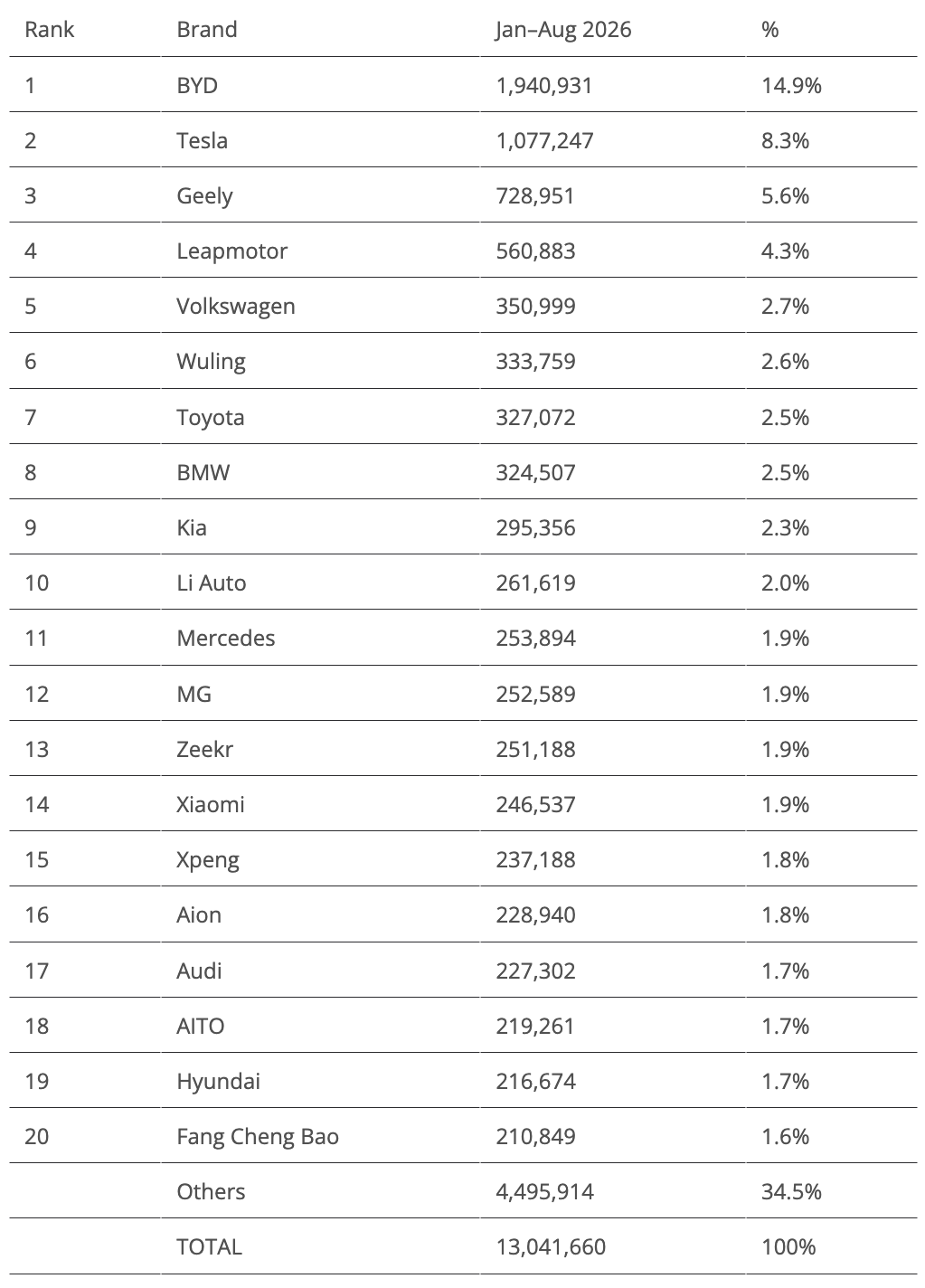
Leapmotor recorded more than 100,000 sales for the second consecutive month, setting another record and posting 81% growth. It moved ahead of Geely in August. Geely’s reliance on the Xingyuan for high volume is becoming more visible, while Leapmotor’s latest results point to broader momentum across its range.
Toyota also set a monthly record, with 52,576 registrations, and finished ahead of Volkswagen. It was the leading established automaker in the August brand table. Its volume came from several sources: the RAV4 PHEV and bZ4X contributed, as did its Chinese-built bZ7 sedan and bZ3X compact crossover, which together delivered about 15,000 units during the month.
Other Chinese brands had strong showings. Wuling, Fang Cheng Bao and Xpeng each recorded their best results of the year. Xpeng’s leading model was the Mona L03, a new crossover that registered 8,424 units in only its second month on sale. Zeekr doubled sales to a record 36,981, helped in part by exports; its 7X crossover recorded 1,748 deliveries in Australia. Chery reached a record 31,667 deliveries, with the QQ3 EV a major contributor.
Through August, Toyota rose to seventh in the brand rankings as BMW lost two places. Toyota was fewer than 25,000 units behind Volkswagen in fifth, with four months remaining in the year. The gap makes a climb possible, but it will depend on whether Toyota can maintain its record pace. Zeekr rose to 13th, Xpeng to 15th and GAC’s Aion to 16th. Aion’s exports included 979 UT hatchbacks in Brazil and 634 V crossovers in Thailand. BYD’s premium Fang Cheng Bao brand entered the table in 20th, supported by the Ti 7.
BYD leads by group, with room for challengers
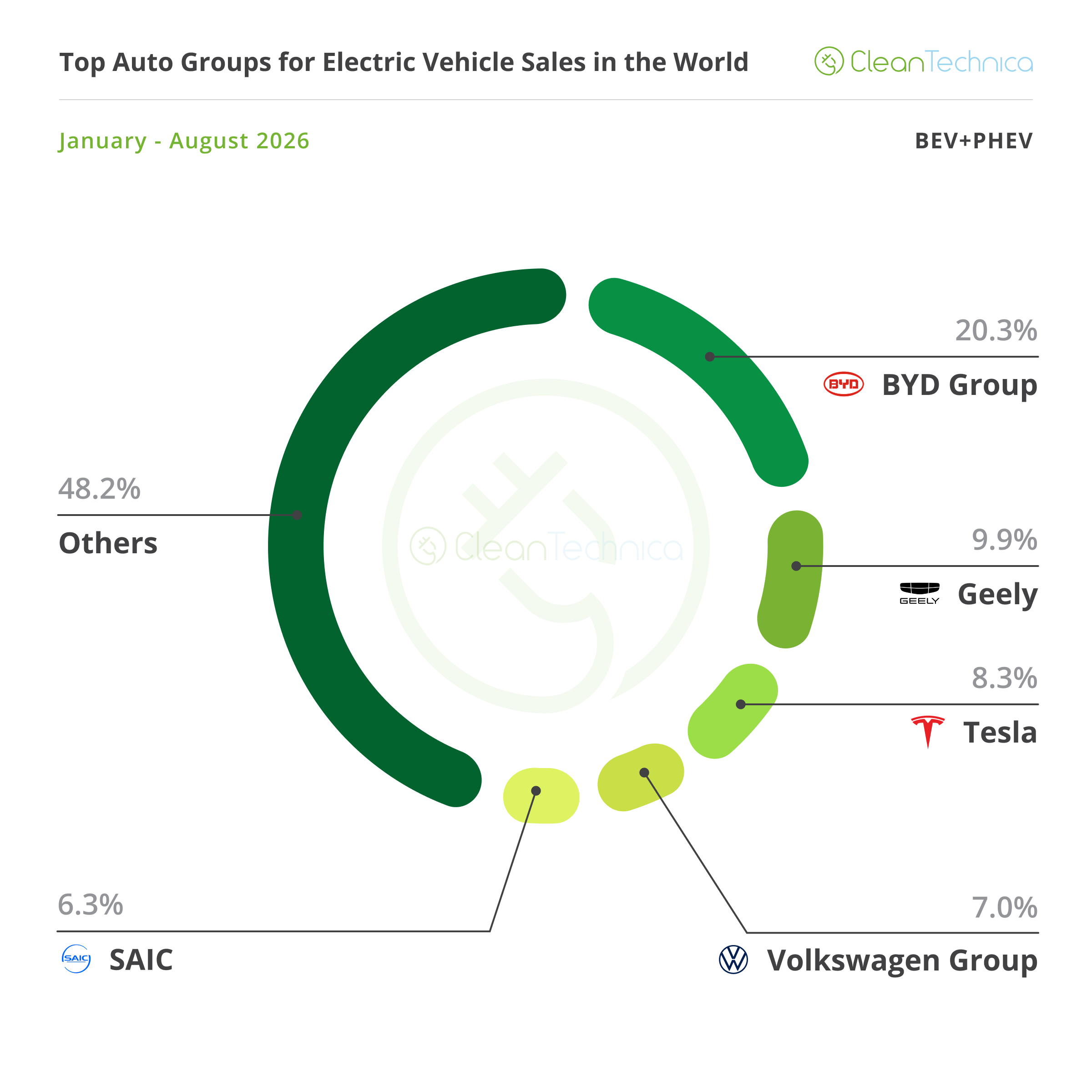
By automaker group, BYD led the year-to-date plugin market with a 20.3% share. Geely was second at 9.9%, ahead of Tesla at 8.3%. Volkswagen Group held fourth at 7%, down from 7.2% in July, while SAIC stayed fifth at 6.3%. Leapmotor moved up to 4.3%, compared with 4.1% the previous month, as Hyundai–Kia slipped to 4%.
Toyota stood 11th at 2.9%, up 0.1 percentage point, while BMW was at 3%, down by the same amount. The standings were similar to a year earlier, but several leaders had lost ground: BYD’s share was 2.4 percentage points lower than in August 2025, and Geely’s was 0.9 points higher than its current level. The movement below the leaders suggests that sales are spreading across more manufacturers.
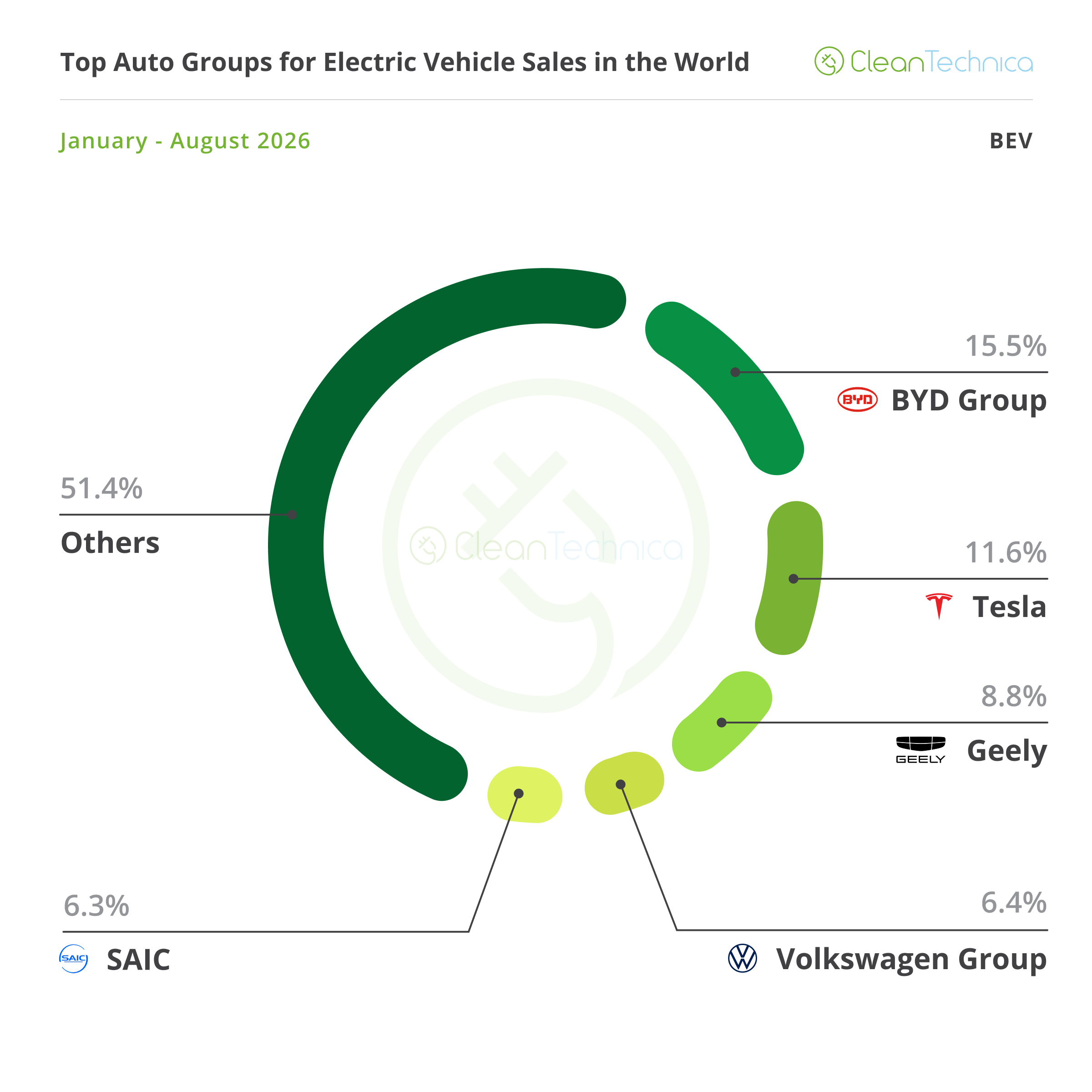
BEVs accounted for about 9.2 million registrations through August, or 71% of plugin sales. BYD led that category with a 15.5% share, followed by Tesla at 11.6%, down 0.2 points. Geely held third at 8.8%, up from 8.7% in July. Volkswagen Group had 6.4%, while SAIC was close behind at 6.3% and could move into fourth.
Hyundai–Kia held 4.5% of BEV sales, up from 3.8% a year earlier. Leapmotor’s share more than doubled over the same period, reaching 4.5% in the BEV comparison. These gains sit alongside the erosion in share among the five leading groups, another sign that the field is broadening. The current year may leave the leading positions largely intact, but the rise of newer competitors gives the next year a different shape to watch.