In lane Electric Vehicles
GM Targets Eyes-Off Highway Driving for SUVs and Pickups After Escalade IQ
Description
GM plans to extend eyes-off highway driving beyond Cadillac’s Escalade IQ, using shared computing hardware, vehicle data and simulation to scale the system.
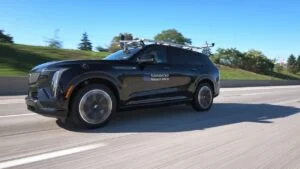
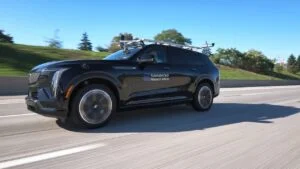
GM’s plan to bring eyes-off highway driving to its high-volume SUVs and light-duty pickups could take the technology beyond premium electric vehicles and into some of the company’s most widely sold models. The expansion is planned for the years after the Cadillac Escalade IQ becomes the first announced application, currently scheduled for 2028.
The company describes the move as a shift from a limited debut toward broader availability. It hasn’t named the SUV and truck models that will get the system, or provided timing for those later launches. That leaves the central buyer question open: when will drivers be able to use eyes-off capability in specific vehicles, and under what operating conditions?
GM’s announcement frames the technology around giving occupants time back during routine journeys. Its longer-term vision includes vehicles handling everyday trips, such as going to collect groceries or dry cleaning. Those examples describe an ambition, rather than a confirmed feature set or availability plan for the upcoming SUVs and pickups.
From driver assistance to eyes-off driving
GM’s Super Cruise and Tesla’s Full Self-Driving (Supervised) can manage steering and speed in certain settings, but drivers must continue to pay attention, Reuters reports. Some existing systems allow hands-free driving while still requiring active supervision. Eyes-off operation represents a different level of responsibility for the vehicle, so the distinction between the planned system and today’s driver assistance will matter as GM explains its operating limits.
Mercedes-Benz is among the few automakers to have introduced eyes-off systems, according to the source article. Their use is generally confined to relatively small areas and lower speeds. GM’s stated ambition for highway travel across popular vehicle lines points to a broader potential application, though the company hasn’t yet specified where or when its system will work.

The initial vehicle GM has identified is the Cadillac Escalade IQ, announced as the first model for eyes-off highway driving in 2028. The planned move into high-volume SUVs and light-duty pickups could give the technology a much wider audience than a launch limited to that electric luxury SUV. For buyers comparing future models, the practical details will include which trims and powertrains qualify, what routes are supported, and whether the feature needs an ongoing connection or additional equipment. GM hasn’t supplied those details.
Shared computing across different vehicles
GM says a new central computing architecture is intended to let software run across a broad range of vehicles while each model retains hardware and controls suited to its use. That separation could make it easier to carry software improvements from one vehicle line to another without requiring every model to use identical components.
At the center is a liquid-cooled computing unit that GM says offers 40 times more computing capability. The company says the unit brings autonomy, active safety, chassis and propulsion software together on a single high-speed core. Its claim describes a platform meant to handle several vehicle functions; the company hasn’t provided a like-for-like benchmark or further detail about the comparison behind the 40-times figure.
Regional hubs are also intended to gather signals from sensors and actuators, replacing more complex wiring harnesses with a high-speed data backbone. GM says its high-speed Ethernet supports 36 times more data than previous systems. Together, the central unit and regional hubs are presented as common foundations that can support different models and future software updates.

GM says improvements validated on one model can be distributed across its vehicle range through frequent over-the-air updates. That approach could help the company expand software across multiple nameplates as they enter production. Actual update frequency, vehicle eligibility and the scope of changes haven’t been specified.
Training the system with road and simulated data
The company says its development work draws on 1.2 billion hands-free miles driven by Super Cruise customers. It also operates hundreds of data collection vehicles, which GM says gather 1 million miles of full-rate, multisensor data each month across different weather, traffic patterns and unusual situations. Customer vehicle data is included when drivers have opted in.
GM combines those real-world examples with AI and machine learning tools. Its account also describes reinforcement learning, in which a system uses simulated experiences to build on what it has learned from road data. For a highway merge, for example, simulations can vary the actions of both the merging vehicle and surrounding traffic. The system can repeatedly practice deciding when to yield, change speed or take an available gap.
In closed-loop, multi-agent training, the simulated vehicles and scenarios can challenge one another as the driving software improves. GM says this lets it raise the difficulty of practice scenarios to cover more variation. The method may help teams explore situations that are difficult to encounter in ordinary driving, though the company hasn’t given a performance measure linking virtual training to on-road results.
GM says its system runs through more than 3 billion virtual miles each day, equivalent to about 1,200 miles per day for each virtual vehicle. The company estimates it would take about 2.5 million vehicles to produce the same daily distance on roads. These figures describe the scale of simulation in GM’s development process; they don’t, by themselves, show how the finished system will perform in customer vehicles.
GM’s autonomy platform combines the computing architecture with new high-resolution, low-cost radar and machine learning. The company’s stated aim is to reuse this stack across popular retail models, building on its experience with Super Cruise. Concept Horizon offers a glimpse of the cabin experience GM is considering, with space intended for passengers to relax or work during autonomous highway journeys. The next concrete milestones are the Escalade IQ’s planned 2028 introduction and details on which SUVs and pickups will follow.